

Best Mobile Plans in Canada for International Students (2026 Guide)
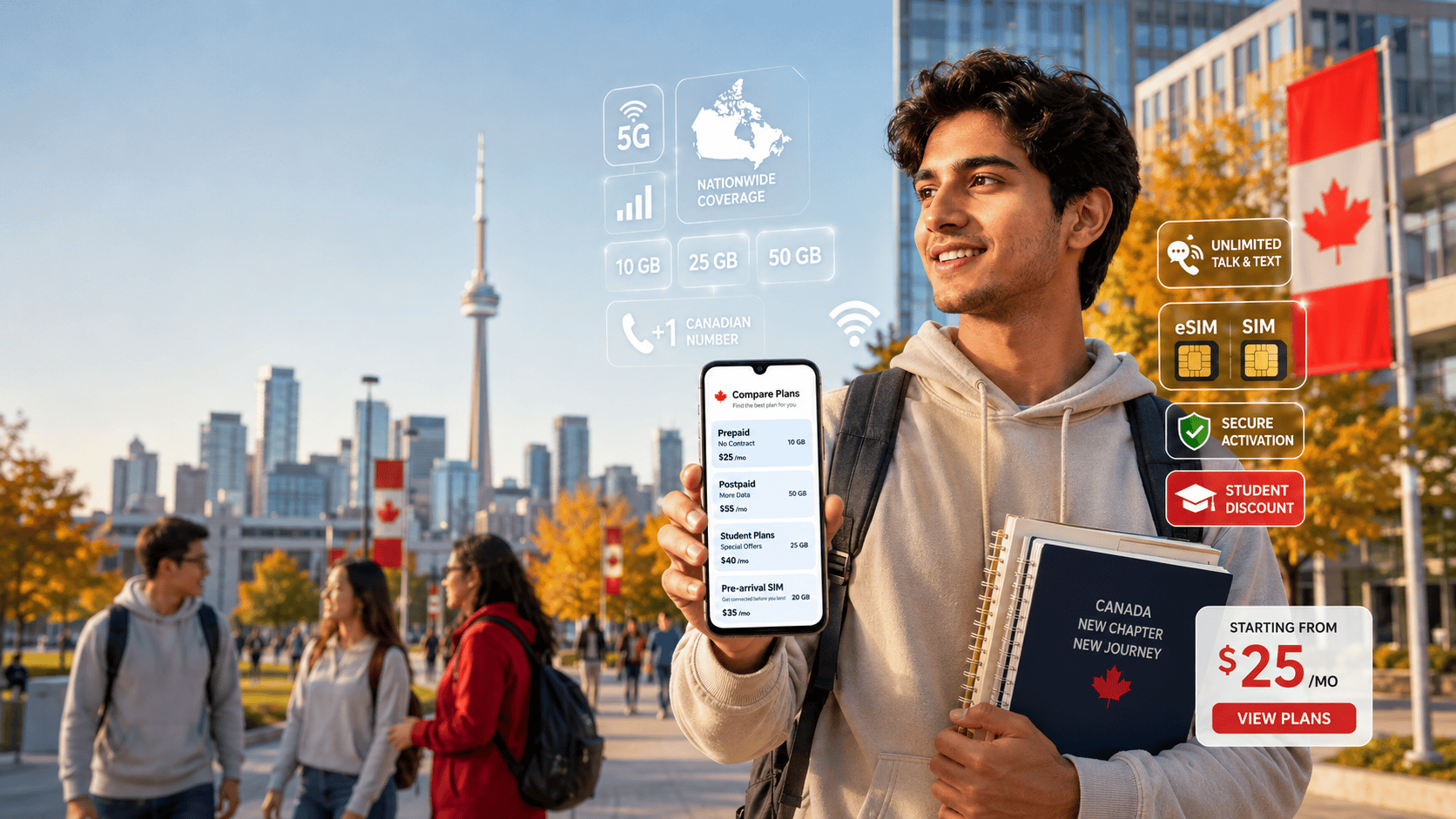
Choosing the best mobile plan in Canada as an international student comes down to three things: how much data you use, whether you want prepaid or postpaid, and how soon you need a working number. This guide walks through all three honestly — including when a big-carrier plan or a discount brand is the better call than ordering ahead.
There's no single "best" plan for every student. There's a best plan for your budget, phone, and length of stay. Let's find yours.
Key takeaways
- Most students do fine on 10–50 GB a month, especially with campus and home Wi-Fi.
- Prepaid means you pay first with no contract or credit check; postpaid means you're billed monthly and usually pass a credit check.
- As a newcomer with no Canadian credit history, prepaid is often the easiest way to start.
- Big carriers, discount brands, and prepaid providers all serve students well — the right pick depends on price, data, and coverage.
- A pre-arrival SIM or eSIM is worth it if you want a Canadian number active before orientation week.
How much mobile data does a student actually need in Canada?
Most students need less data than they expect, because campuses, libraries, and homes have Wi-Fi. Your phone uses mobile data only when you're away from Wi-Fi — walking between classes, on transit, or out with friends.
Here's a realistic guide:
| Your usage | Rough monthly data | Looks like |
|---|---|---|
| Light | 5–10 GB | Messaging, maps, email, some social, mostly on Wi-Fi |
| Average | 10–25 GB | Daily social, music, occasional video off Wi-Fi |
| Heavy | 30–50 GB+ | Lots of video, streaming, hotspot for a laptop |
If you stream video on transit or tether your laptop often, aim higher. If you're on Wi-Fi most of the day, you can save money with a smaller plan. Buying a huge plan you never use is the most common student overspend.
Prepaid vs postpaid: which is better for international students?
For most newcomers, prepaid is the easier starting point because it needs no credit history. Here's the plain-English difference:
- Prepaid: You pay for the month up front. No contract, no credit check, and you can't be surprised by overage. If you don't top up, service simply pauses. Great when you've just arrived and have no Canadian credit yet.
- Postpaid: You're billed at the end of each month and can spread a phone's cost over the plan. It usually needs a credit check or a deposit for newcomers, but it can carry more data and perks.
A quick note for later: postpaid plans may help build credit history if the provider reports to a credit bureau, while prepaid typically does not. Don't choose a plan for that reason alone — read how to build credit in Canada as a newcomer for the full picture.
What are the main types of student phone plans in Canada?
Students generally choose among four routes, from premium networks to budget prepaid. Each has a clear "best for."
| Plan type | Examples | Typical monthly price | Contract | Best for |
|---|---|---|---|---|
| Big carrier (postpaid) | Rogers, Bell, Telus | Higher end | Often | Best coverage, financing a new phone |
| Discount brand (postpaid) | Fido, Koodo, Virgin, Freedom | Mid-range | Sometimes | Good balance of price and network |
| Prepaid | Chatr, Public Mobile, Lucky Mobile | Lower end | None | No credit check, predictable cost |
| Pre-arrival SIM / eSIM | Get Canada Sim | Pre-arrival pricing | None | A number active before you land |
All four can be a fair choice. Big carriers win on coverage and phone financing. Discount brands trim the price on similar networks. Prepaid is simplest for a fresh arrival. And a pre-arrival SIM matters most in one situation — you want to be reachable before you've even set foot on campus.
If you'll be in Canada for years and want to finance a flagship phone, a big-carrier postpaid plan may genuinely suit you better than a prepaid SIM. That's a fair trade-off worth naming.
Where does Get Canada Sim fit — and who is it for?
Get Canada Sim is for students who want a Canadian number working before they arrive, without a Canadian credit check. It's not trying to replace a long-term campus plan for everyone — it's built for the arrival gap.
It's a strong fit if you:
- Want your Canadian number live for study-permit paperwork, your bank appointment, and reaching your school on day one.
- Have no Canadian credit history and want to skip deposits and credit checks.
- Prefer an instant eSIM by email, or a physical SIM delivered to a Canadian address.
It's probably not the best fit if you:
- Want to finance a brand-new phone over 24 months (a postpaid carrier plan handles that).
- Will only ever use Wi-Fi and need almost no mobile data.
Get Canada Sim plans include a real Canadian number, calling, texting, and data, with no contract. See current options and data amounts on the plans page, and how delivery works in how it works.
Budget tips for students on a phone plan
You can cut your phone costs without cutting yourself off. A few tactics students use:
- Lean on Wi-Fi. Campus, library, and home Wi-Fi cover most of your day. Buy data for the gaps, not the whole day.
- Right-size your plan. Start smaller and move up only if you actually run out. It's easy to overpay for unused gigabytes.
- Use dual SIM. Many phones hold an eSIM and a physical SIM at once. Keep your home number active on one and your Canadian number on the other, so family can still reach you cheaply.
- Watch your data settings. Set video apps to lower quality on mobile data, and turn on your phone's data-saver.
- Split or share where allowed. Some providers offer multi-line discounts if you and roommates sign up together.
Arrival-week checklist for students
Your first week is busy — here's the order that keeps your phone from being the bottleneck:
- Before you fly: unlock your phone, confirm eSIM support, and order a SIM so your Canadian number is ready.
- Day 1: land, connect, and test a call and text.
- Day 1–2: book or attend your bank appointment; give the bank your Canadian number.
- Day 2–3: apply for your SIN (Social Insurance Number) if you'll work — the Government of Canada SIN page explains how.
- Orientation week: register for campus Wi-Fi, add your number to school and job portals, set up transit and rideshare apps.
- End of month one: review your data use and adjust your plan up or down.
Keep this list on your phone and tick it off — a working number is what unlocks nearly every step.
Frequently asked questions
What is the best phone plan for international students in Canada?
There's no single best plan — the right one depends on your data use, budget, and stay length. Prepaid plans suit students who want no credit check and predictable costs; postpaid carrier plans suit those financing a phone or wanting maximum coverage. A pre-arrival SIM is best if you want a number active before you land.
Is prepaid or postpaid better for a new student in Canada?
Prepaid is usually easier at first because it needs no Canadian credit history or deposit. Postpaid can offer more data and phone financing but often requires a credit check. Many students start prepaid, then switch to postpaid once they've built some credit history.
How much data do students really use per month?
Most students use 10–25 GB a month once campus, library, and home Wi-Fi cover the rest of their day. Light users can manage on 5–10 GB; heavy streamers and laptop-tetherers may want 30–50 GB or more. Start moderate and adjust.
Can I get a Canadian phone plan without a credit history?
Yes. Prepaid plans and pre-arrival SIMs don't require a Canadian credit check, which makes them the simplest option for a just-arrived student. Postpaid plans from big carriers may ask for a credit check or a deposit until you've built local credit.
Should I keep my home country number too?
If your phone supports dual SIM, keeping your home number on an eSIM while using a Canadian number for daily life is a smart, low-cost setup. Family can still reach you on your old number, and Canadian services can text your new one.
Ready to compare? Find the right option for your stay — or read eSIM vs physical SIM if you're unsure which SIM type to pick.
Last updated: July 2026. Written by the Get Canada Sim team.
Follow Get Canada Sim on Google
Make Get Canada Sim a preferred source to find our latest Canada SIM and eSIM guides in Google Search.