

Best Prepaid SIM Cards in Canada: Compare Plans, Networks & Value
If you are coming to Canada, you probably do not want to spend your first day comparing phone companies.
You want straightforward answers:
Which prepaid SIM should I get? Will the network work where I am staying? How much data do I actually need? Should I choose eSIM or a physical SIM? And is prepaid even the right choice for me?
The answer changes depending on why you are coming to Canada.
A tourist staying for two weeks usually needs something very different from an international student staying for two years. A worker who regularly uses a laptop hotspot has different needs from someone who spends most of the day on Wi-Fi. A newcomer planning to stay long term should also think beyond the cheapest first month.
That is why this guide compares the best prepaid SIM cards in Canada by the decision you actually need to make, rather than simply ranking companies by how much data they advertise.
There is also one important point to understand at the beginning: Rogers no longer sells its own direct prepaid mobile service. Rogers now directs prepaid customers to Chatr, which provides prepaid service powered by the Rogers network. Fido also currently directs prepaid shoppers to Chatr.
So if you specifically want prepaid service with the Rogers network behind it, Chatr is the option to compare.
But if you are an international student, worker or newcomer staying in Canada for many months, do not assume prepaid is automatically your best choice. I would first compare current Rogers, Fido and other Canada SIM plans and then decide whether prepaid still makes more sense.
If you already know you want to pay upfront and avoid an ongoing monthly arrangement, you can instead review prepaid eSIM options for Canada.
And if you are only coming for a short trip, the Canada SIM and eSIM options for tourists will be more relevant than plans designed for someone staying a year.
The goal of this guide is simple: by the end, you should know which type of Canadian SIM makes sense for you and which options you can ignore.
Best prepaid SIM cards in Canada: quick answer
If you want the decision before reading the full comparison, start here.
| Your situation | Start by comparing | Why |
|---|---|---|
| Tourist staying up to a month | Chatr prepaid | Prepaid service powered by Rogers, with physical SIM and eSIM options |
| Tourist who wants service arranged before travelling | Pre-arrival prepaid/eSIM options | Lets you understand the plan and setup before landing |
| International student staying a semester or longer | Rogers first, then Fido | Long-term value can matter more than prepaid status |
| Worker staying several months or longer | Rogers first | Compare network, data and hotspot needs before defaulting to prepaid |
| Newcomer staying long term | Rogers first, then Fido | A monthly Canadian plan may fit an ongoing stay better |
| You definitely require prepaid + Rogers network | Chatr | Rogers directs prepaid customers to Chatr |
| Higher-data prepaid alternative | Public Mobile | Current prepaid/subscription offers include larger 4G and 5G data tiers |
| Light mobile-data use | Lucky Mobile or Koodo | Lower-entry prepaid plans may be enough |
| You specifically want eSIM | Choose the plan first | eSIM is a SIM format, not a reason by itself to choose a weaker plan |
Chatr currently lists plans including 1GB for $21, 5GB for $25, 15GB for $30 and 30GB for $35, with some allowances depending on Auto-Pay. Its plans use 4G service powered by Rogers.
Public Mobile currently lists options from $20 for 1GB through a $35 Canada-wide plan with 50GB at 5G speed, plus larger Canada-US-Mexico plans.
Lucky Mobile currently starts at $19 and lists 30GB for $35 with Auto Top-Up, while also including hotspot capability on its listed plans.
What I recommend
For a tourist who definitely wants prepaid, Chatr is where I would start because it is the prepaid path for someone who wants service powered by the Rogers network. Chatr also specifically offers tourist eSIM activation before or after arrival.
For an international student, worker or newcomer staying longer, my first comparison would be Rogers rather than automatically choosing prepaid. Then compare Fido as another monthly option. You can compare the current Canada SIM and eSIM plans side by side before committing.
That distinction matters.
Tourist or short stay → prepaid deserves priority.
Longer stay → compare Rogers/Fido monthly plans before deciding that prepaid is best.
Anyway, if you don't know what an eSIM is, you should know that first.
What should you look for in a prepaid SIM card in Canada?
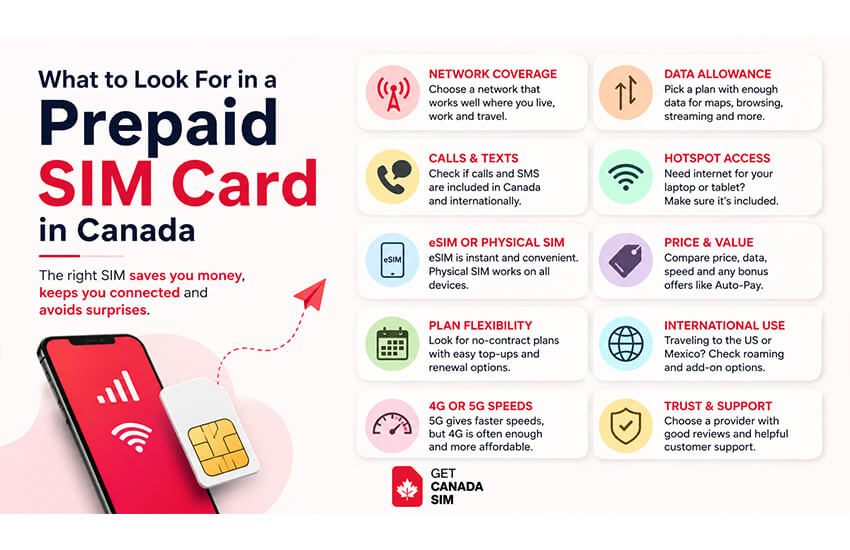
A prepaid SIM means you pay for your mobile service before you use it. You normally add enough money to cover the plan, use the included service, and top up again if you want to continue.
Before comparing companies, decide these three things:
How long will you stay in Canada? How much mobile data do you actually use away from Wi-Fi? And do you truly need prepaid rather than a monthly plan?
Those answers can remove most of the wrong options immediately.
A tourist staying 12 days does not need the same plan as someone working in Canada for two years.
Likewise, an international student who spends most of the day on campus and home Wi-Fi may not need a huge mobile-data allowance simply because it looks better on a comparison table.
Use this checklist:
| What to check | Why it matters |
|---|---|
| Length of stay | A 10-day trip and a two-year stay need different billing structures |
| Coverage | Check your home, campus, workplace and normal travel areas |
| Data allowance | More data is only better if you actually use it |
| 4G or 5G | Some prepaid providers currently offer only 4G tiers |
| Calls and texts | Important if you want full mobile service rather than data only |
| Hotspot | Check this if you plan to connect a laptop or tablet |
| eSIM support | Your phone must support eSIM to use a digital SIM |
| Automatic payment | Some advertised data bonuses depend on Auto-Pay or Auto Top-Up |
| Expiry/renewal | Know whether the service renews, stops or requires another top-up |
| International use | Check Canada-US-Mexico or roaming rules if relevant |
| Phone compatibility | An unlocked compatible device is essential |
If you are still unsure whether you want digital or physical service, first see how eSIM works in Canada.
My decision: choose based on your stay and usage first. Do not choose a provider only because its plan says 50GB instead of 30GB.
Rogers vs Fido vs Chatr vs Public Mobile vs Lucky Mobile vs Koodo vs Freedom Mobile
The first thing to understand is that these companies do not all sell the same type of service.
| Provider | Relevant service type | Main point to know |
|---|---|---|
| Rogers | Monthly/postpaid | No new direct Rogers prepaid service; worth comparing first for longer stays |
| Fido | Monthly/postpaid | Currently directs prepaid shoppers to Chatr |
| Chatr | Prepaid | Powered by the Rogers network |
| Public Mobile | Prepaid/subscription | Offers both 4G and 5G-speed plans |
| Lucky Mobile | Prepaid | Low-entry plans, 4G LTE and Auto Top-Up bonuses |
| Koodo Prepaid | Prepaid | Multiple monthly and longer-term prepaid choices |
| Freedom Mobile | Prepaid and monthly | Another option where its network and plan conditions fit your location |
Rogers states that prepaid customers now need to use Chatr, while Chatr states that its prepaid service is powered by the Rogers network. Fido's current site likewise promotes Chatr when users look for prepaid service.
The practical decision
Want Rogers itself and staying longer? Compare Rogers monthly plans first.
Want another monthly option and do not require prepaid? Compare Fido.
Want actual prepaid service powered by Rogers? Choose Chatr as your first comparison.
That is more useful than treating Rogers, Fido and Chatr as interchangeable.
What is the best prepaid SIM card in Canada for tourists?
If you are visiting Canada, your thinking is probably simple:
“I only need the service for my trip. I do not want to keep paying after I leave.”
In that situation, prepaid makes sense.
Chatr is my first provider to compare for a tourist who wants a normal Canadian prepaid line, especially if being on a Rogers-powered network matters.
Chatr currently promotes tourist prepaid eSIMs that can be activated online before or after arrival. It also offers physical SIMs through retail locations. Its plans have no term contract, and its tourist page says the service is powered by Rogers.
My recommendation for tourists
Staying a few days to about a month: start with Chatr prepaid.
Want to arrange the decision before your flight: compare the prepaid Canada SIM and eSIM options for tourists.
Only need maps, messaging and internet: a data-only travel eSIM may be enough.
Staying several months: stop thinking like a tourist and compare Rogers or Fido monthly plans.
Do not buy the largest plan simply because you are worried about running out of data.
For a short trip, trip length is usually the first filter.
Related: Which eSIM Company Is the Best in Canada?
What is the best prepaid SIM card in Canada for international students?
Students have a different decision.
You may be thinking:
“I will be here for eight months or several years. I want a reasonable monthly cost and enough data, but I do not want to pay for data I barely use.”
That is why I would not automatically recommend prepaid to an international student.
Start by comparing Rogers and Fido monthly options.
Why?
Because you are not solving a 10-day travel problem. You are choosing a plan that you may keep paying for month after month.
If you spend most of your day using campus, residence and home Wi-Fi, your actual mobile-data use may be lower than expected.
If you commute frequently, stream video away from Wi-Fi or use your phone heavily, your needs change.
International students can compare options designed around a longer stay on the Canada SIM page for international students.
My recommendation for students
First comparison: Rogers.
Second comparison: Fido.
If prepaid is non-negotiable: Chatr first, then Public Mobile or Koodo.
This approach protects you from choosing prepaid simply because your original Google search contained the word “prepaid.”
What is the best prepaid phone plan in Canada for workers?
A worker's decision should start with how the phone will be used during the working day.
Someone working from one office with Wi-Fi may barely use mobile data.
Someone travelling between job sites may depend on it constantly.
Someone using a laptop away from Wi-Fi may care more about hotspot support than another 20GB of headline data.
So ask:
Where will I work?
Will I travel between cities or sites?
Will I use hotspot?
How long will I stay in Canada?
For a longer work permit, Rogers is the first provider I would compare, rather than limiting yourself to prepaid.
Then compare Fido if its current plan structure fits your usage.
If you specifically need prepaid, Chatr becomes the Rogers-powered option to investigate.
The Canada SIM guide for work permit holders is the better next step for someone staying in Canada for work rather than a short holiday.
My recommendation for workers
Long stay: Rogers first.
Lower-use long stay: compare Rogers and Fido.
Prepaid required: Chatr first.
Laptop tethering required: verify hotspot support on the exact plan before ordering.
What is the best prepaid SIM in Canada for newcomers?
A newcomer may be thinking:
“I do not yet know how much data I will use or which provider I will want six months from now.”
That uncertainty is a good reason to consider prepaid.
You can start with something simple while learning your normal usage.
For someone specifically wanting prepaid, Chatr is the first option I would compare because it provides prepaid service powered by Rogers.
But if you already expect to remain in Canada long term, compare Rogers and Fido at the same time.
A flexible first month is useful.
A good long-term plan is more important.
My recommendation for newcomers
Not sure what you need yet: start by comparing Chatr prepaid.
Know you are staying long term: Rogers first, then Fido.
Want to compare everything before deciding: use the full Canada SIM and eSIM plan comparison.
Your first Canadian SIM does not have to be the plan you keep forever.
Where to buy a prepaid SIM card in Canada in 2026
There are three practical ways to get one:
at the airport, in a city store, or online.
The best choice depends mainly on whether you want convenience before or after arrival.
Buying a prepaid SIM card at the airport
Buying at an airport can be useful if you arrive without service and want staff to help immediately.
For example, Chatr currently sells prepaid SIM and eSIM service at Toronto Pearson. Its Pearson locations are in Terminals 1 and 3, and the company also lets compatible-phone users activate an eSIM online instead.
Best for: someone who wants face-to-face help after landing.
Trade-off: you are making the decision after a flight rather than comparing calmly beforehand.
Buying a prepaid SIM card in the city
You can also visit mobile stores or participating retailers after arriving.
Chatr says it has more than 3,000 stores across Canada, along with additional locations where top-up cards are available.
Best for: someone who wants in-person assistance and does not need service immediately on arrival.
Buying a prepaid SIM card online
For many international travellers, online is the easier decision because you can research while you still have time.
If your phone supports eSIM, you may also avoid collecting a physical card entirely.
Chatr lets tourists activate an eSIM online before or after arrival.
You can also review prepaid eSIM options for Canada before travelling.
My recommendation
If you already know you will need Canadian mobile service, compare your options before travelling.
You do not have to buy immediately.
The advantage is simply that you have time to understand the plan before you land.
Which mobile network has the best coverage in Canada?
There is no responsible one-word answer.
National network studies show Rogers, TELUS and Bell each leading different measures rather than one carrier dominating everything.
Summaries of Opensignal's February 2026 Canada Mobile Network Experience report show TELUS with the most total national awards, Rogers with more outright wins than the other two, Rogers and TELUS sharing leadership for reliability and consistent quality, and Bell leading 5G download speed.
That means the question:
“Which network is best in Canada?”
should really become:
“Which network works well in the places where I will actually live, study, work and travel?”
Does Rogers have good network performance in Canada?
Yes, Rogers belongs near the top of the comparison.
In the cited February 2026 Opensignal results, Rogers was especially competitive in upload performance, reliability-related measures and 5G availability.
That is one reason Rogers is my first comparison for a student, worker or newcomer who is not restricted to prepaid.
Does TELUS have the best coverage in Canada?
TELUS performs very strongly nationally, but calling it universally “the best coverage in Canada” is too broad.
The latest national performance results are mixed by category, and your own experience depends on location.
So I would not choose TELUS—or any other carrier—on a nationwide ranking alone.
Are Bell and Rogers strong only in cities?
No.
That is another oversimplification.
All major Canadian networks extend beyond major cities, and network differences can matter inside cities as well as outside them because signal depends on buildings, terrain, congestion, device compatibility and the exact location.
Always check the places that matter to you.
Do prepaid SIM cards in Canada have 5G?
Some do.
But not all prepaid providers give you 5G service.
For example, Public Mobile currently lists both 4G and 5G-speed plans, including a Canada-wide 50GB plan at 5G speed for $35.
Chatr, on the other hand, currently markets its prepaid data as 4G, even though the service is powered by the Rogers network.
That distinction is important.
Using the Rogers network through Chatr does not mean you automatically receive the same network tier as a Rogers 5G plan.
My recommendation
If prepaid is your main requirement, start with Chatr and compare its 4G service against other prepaid options.
If Rogers + 5G is your priority, compare Rogers monthly plans instead of forcing yourself into prepaid.
Prepaid SIM card prices in Canada in 2026
Prices change frequently, so the figures below were checked in early September 2026 and should be verified again before publication or purchase.
| Provider | Example current prepaid pricing | Notes |
|---|---|---|
| Chatr | $21/1GB, $25/5GB, $30/15GB, $35/30GB | Some data includes Auto-Pay bonuses |
| Public Mobile | $20/1GB, $24/5GB, $28/10GB, $30/35GB, $35/50GB | Mix of 4G and 5G-speed tiers |
| Lucky Mobile | $19/500MB, $21/1GB, $25/5GB, $30/15GB, $35/30GB | Some data depends on Auto Top-Up |
| Koodo Prepaid | Current plans vary | Includes lower-use and higher-data prepaid tiers |
| Freedom Mobile | Current plans vary | Check location, coverage and current offer |
Chatr pricing and allowances are shown on its current prepaid-plans page. Public Mobile's current page lists its Canada-wide tiers and larger cross-border options. Lucky Mobile currently lists its $19–$35 prepaid range.
Rogers prepaid SIM card plans
You will still see people searching for Rogers prepaid SIM Canada, but Rogers does not currently sell direct prepaid service to new prepaid customers.
Rogers tells prepaid customers to use Chatr instead.
So:
Want Rogers itself? Compare Rogers monthly service.
Want Rogers-powered prepaid? Compare Chatr.
Fido prepaid SIM card plans
Fido currently directs prepaid shoppers to Chatr as well.
That means Fido is more relevant here as a monthly alternative for a longer-term user, not as the primary prepaid recommendation.
Chatr prepaid SIM card plans
Chatr is the most direct answer for someone searching for Rogers prepaid SIM Canada.
Its current lineup includes plans from $21/month through $35/month, plus a $159 annual option with 40GB. The monthly plans include Canada-wide calling and Canada/US/international texting, with bonus data on eligible Auto-Pay tiers.
My decision: if you insist on prepaid and want the Rogers network behind the service, start here.
Public Mobile prepaid plans
Public Mobile currently has strong data allowances for the price, particularly higher up its range.
Its $30 Canada-wide plan currently includes 35GB at 4G speed, while the $35 tier includes 50GB at 5G speed.
My decision: compare Public Mobile when data-per-dollar and 5G prepaid matter more than specifically using a Rogers-powered option.
Lucky Mobile prepaid plans
Lucky Mobile currently starts at $19 for 500MB, with larger Auto Top-Up tiers up to 30GB for $35. Its plans currently use 4G LTE speeds.
My decision: worth comparing for lighter-use prepaid service.
If your priority is Rogers-powered prepaid service, I would still start with Chatr.
What is the cheapest prepaid SIM card in Canada?
The lowest advertised monthly price is not automatically the cheapest plan for you.
For example, a $19 plan can look attractive.
But if you regularly need 20GB of data, buying a tiny plan and then repeatedly adding more service may not save money.
Instead, ask:
What is the lowest-priced plan that comfortably covers my normal usage?
A light user may genuinely be fine with an entry-level plan.
A student watching video on mobile data every day will probably not be.
A tourist using hotel Wi-Fi for most of the trip may need less than either.
That is why “cheapest prepaid SIM Canada” should be treated as a usage question, not just a price-ranking question.
Which prepaid SIM gives the most data for around $35?
Among the current plans reviewed, Public Mobile is particularly competitive at this price point.
Its Canada-wide $35 plan currently includes 50GB at 5G speed. Chatr currently lists 30GB at $35, while Lucky Mobile currently lists 30GB at the same monthly price.
If your main priority is:
“Give me a lot of prepaid data for around $35,”
Public Mobile deserves serious consideration.
If your priority is:
“I specifically want prepaid powered by Rogers,”
I would choose Chatr as the first comparison instead.
The “best” answer changes with the question.
Do you need a SIM card for Canada?
Not always.
Your choices can include:
| Option | When it may make sense |
|---|---|
| Keep your home SIM on roaming | Very short trip and your existing plan has reasonable Canadian roaming |
| Travel eSIM | Short trip where you mainly need mobile data |
| Canadian prepaid SIM/eSIM | Shorter stay where you want Canadian mobile service without a long commitment |
| Canadian monthly plan | Student, worker or newcomer staying longer |
If you already have affordable Canada roaming through your home carrier, use that in the comparison.
There is no benefit in buying another plan just because you are crossing the border.
If you are staying longer, however, comparing Canadian service becomes more important.
Can you use a USA or Mexico SIM card in Canada?
Yes, if your existing plan allows Canadian roaming or includes Canada in its service area.
For example, some North American plans include usage across Canada, the US and Mexico.
But the SIM's country of origin is not the most important question.
Check:
Does my plan include Canada?
Then check the data allowance, speed, calls, SMS, roaming fees and how long you are allowed to use the plan outside your home country.
My decision
Short trip + Canada already included: keep your current SIM if the conditions are good.
Longer stay in Canada: compare Rogers or another Canadian plan instead of depending indefinitely on international roaming.
Do you need a passport to buy a prepaid SIM card in Canada?
It depends on where and how you buy the service.
For example, Chatr specifically tells customers buying a SIM or eSIM at Toronto Pearson to bring a passport or other government-issued ID because it may be required for registration.
So if you plan to buy a prepaid SIM at an airport:
bring your passport or government-issued ID.
If you activate online or at another provider, check that provider's current identification requirements.
Do not assume every company follows exactly the same process.
Is a prepaid eSIM better than a physical SIM card in Canada?
An eSIM is a digital SIM profile built into a compatible phone.
A physical SIM is the removable plastic card.
The plan behind them matters more than the format.
| Prepaid eSIM | Physical prepaid SIM |
|---|---|
| Delivered/activated digitally | Physical card goes into the phone |
| Useful if you want to keep your home SIM installed | Works with phones without eSIM support |
| No card to lose or swap | Easier to physically move between compatible devices |
| Requires eSIM-compatible device | Requires physical SIM slot |
If you want more detail, read the eSIM vs physical SIM comparison for Canada.
My recommendation
Choose the mobile plan first.
Then choose eSIM if your phone supports it and digital installation is useful to you.
Do not choose a worse plan just because the word “eSIM” appears on it.
Can you keep your home SIM and use a Canadian eSIM?
On many compatible phones, yes.
This is called Dual SIM.
It can allow you to keep your existing home-country line while using a Canadian eSIM for Canadian mobile service.
This can be especially useful for an international student, worker or newcomer who does not want to remove their existing SIM immediately.
The important thing is to manage mobile-data settings carefully so your home SIM does not accidentally use expensive international roaming.
If this setup interests you, start by learning how eSIM works in Canada and what your phone needs.
FAQ about prepaid SIM cards in Canada
Can tourists buy a prepaid SIM card in Canada?
Yes. Tourists can buy prepaid service from Canadian providers, and some providers allow eSIM activation online before arrival. Chatr specifically markets prepaid eSIM options for tourists.
What is the best prepaid SIM card for Canada?
If you specifically want prepaid service powered by Rogers, my first comparison is Chatr. If your main priority is higher 5G prepaid data for the price, Public Mobile is also worth comparing. For a longer stay, I would compare Rogers monthly service before deciding that prepaid is necessary.
Which mobile network is best in Canada?
No single network wins every category nationally. Current independent network reporting shows Rogers, TELUS and Bell leading different measures. Your final choice should depend on coverage where you live, work, study and travel.
How much does a prepaid SIM card cost in Canada?
Among the providers reviewed here, entry-level prepaid plans currently begin around $19–$21 per month, while larger data plans commonly sit around the $30–$35 range. Promotions and bonuses change frequently.
Is it better to buy a SIM card or an eSIM for Canada?
Neither format is automatically better. If your phone supports eSIM and you want digital activation, eSIM can be convenient. If your phone does not support eSIM or you prefer a removable card, use a physical SIM.
Can I buy a SIM card at the airport in Canada?
Yes, at some airports. Chatr currently sells physical SIM and eSIM service at Toronto Pearson, for example. Availability depends on the airport and provider.
Do prepaid SIM cards in Canada include 5G?
Some do and some do not. Public Mobile currently offers prepaid/subscription plans at 5G speed, while Chatr's prepaid plans currently use 4G service.
Can I use a USA SIM card in Canada?
Yes, if your US plan includes Canadian usage or roaming. Check the exact plan terms before travelling.
What is the best prepaid SIM in Canada for international students?
If prepaid is essential, start by comparing Chatr and then Public Mobile or Koodo. If you will be in Canada for a semester or longer, however, I would compare Rogers first and Fido second before choosing prepaid.
What is the best prepaid SIM in Canada for workers?
If you strictly need prepaid, start with Chatr. For a longer work stay, I would compare Rogers first, especially if network performance and ongoing mobile use matter more than prepaid billing.
What is the best prepaid SIM for newcomers to Canada?
Chatr is a logical prepaid starting point for someone who wants Rogers-powered service without committing to a long-term plan. If you already know you will stay in Canada for the longer term, compare Rogers and Fido monthly options as well.
Does a prepaid SIM card require a credit check?
Chatr states that its prepaid plans have no credit checks, no term contracts and no commitment. Requirements can vary between providers and products, so check the exact plan before activation.
Final thoughts: which prepaid SIM card should you choose in Canada?
The best prepaid SIM cards in Canada are not the same for every person.
If you are a tourist, I would start with Chatr because it gives you prepaid Canadian mobile service powered by the Rogers network and offers both physical SIM and eSIM routes.
If you are an international student, I would first compare Rogers, then Fido, because your stay is long enough that monthly value may matter more than prepaid billing.
If you are a worker, Rogers would also be my first comparison for a longer stay. If you specifically want prepaid, move Chatr to the top of the shortlist.
If you are a newcomer, prepaid can be a useful starting point while you learn your normal data use. But if you already know you are staying long term, compare Rogers and Fido as well.
If you mainly care about high prepaid data for around $35, Public Mobile currently deserves consideration.
If you barely use mobile data, Lucky Mobile, Koodo or another lighter prepaid plan may be enough.
So instead of asking only:
“What is the best prepaid SIM card in Canada?”
ask:
“How long am I staying, what will I actually use, and which plan gives me those things without making me pay for features I do not need?”
If prepaid still fits after answering those questions, review the current prepaid eSIM options for Canada.
If you are staying longer and are no longer sure prepaid is right, compare Rogers, Fido and the other available Canada SIM plans before ordering.
Follow Get Canada Sim on Google
Make Get Canada Sim a preferred source to find our latest Canada SIM and eSIM guides in Google Search.