

Canada SIM Card for Tourists: Airport, Roaming, eSIM, or Local SIM?
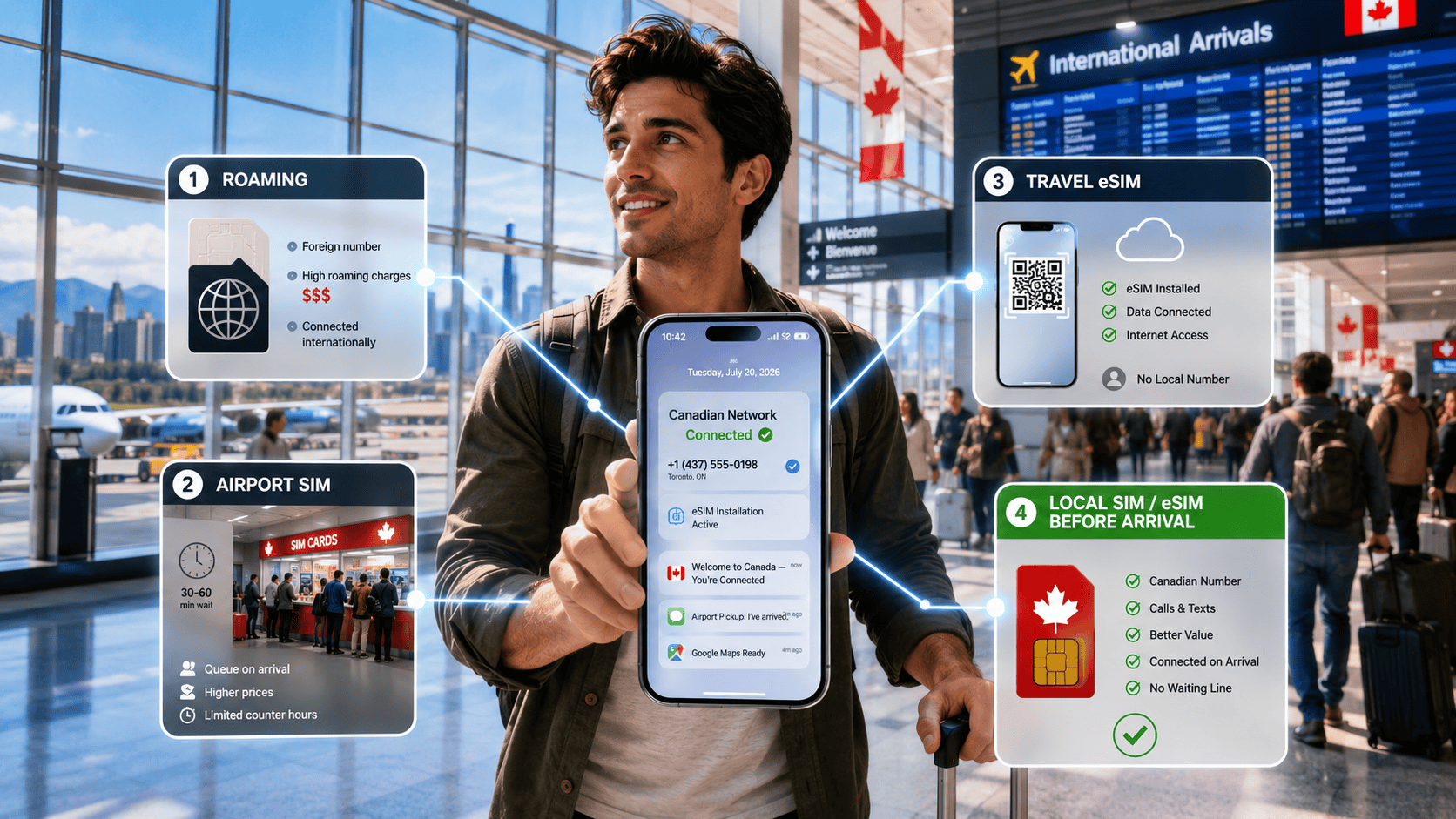
The best Canada SIM card for tourists depends on your trip length and whether you need a phone number or just data. You have four real options: roam on your home plan, buy at an airport kiosk, use a travel eSIM, or order a local SIM before you fly. This guide compares all four honestly, so you can pick the right one and land connected.
A SIM is the chip that connects your phone to a network. An eSIM is a digital version you install from a QR code. Roaming means using your home plan abroad, usually at a premium.
Key takeaways
- Roaming is the simplest but usually the most expensive way to stay connected in Canada.
- Airport kiosks work on arrival but often cost more and mean queuing after a long flight.
- Travel eSIMs are great for quick data, but many are data-only — no Canadian number.
- Ordering a local SIM or eSIM before you fly gives you a Canadian number active on landing, often at the best price.
- Match the option to your trip: days and data-only vs weeks and needing a number.
What are the four ways for tourists to get connected in Canada?
Tourists have four main routes to a working phone in Canada, and each suits a different kind of trip. Before we compare costs, here's what each one actually is:
- Roaming — keep your home SIM and use your existing plan in Canada. Zero setup, highest cost.
- Airport kiosk — buy a Canadian SIM from a counter when you land. Convenient but you queue, and prices are marked up.
- Travel eSIM — buy a data eSIM online for your trip. Fast and simple, but frequently data-only.
- Local SIM or eSIM ordered before arrival — order a Canadian plan before you fly, activated before you land. A real number, usually the best value.
None of these is wrong. The best one depends on how long you're staying and what you need your phone to do.
Option 1: Roaming on your home plan
Roaming is the easiest option and the one you should usually avoid for anything but the shortest trips. You do nothing — your phone just connects in Canada — but your home carrier charges travel rates, often a daily fee on top of your normal bill.
Pros: Zero setup. You keep your own number, so people back home reach you normally.
Cons: It's typically the most expensive route, daily fees stack up fast, and you still have a foreign number that Canadian services can't easily text or call.
Best for: A very short visit of a day or two where you'll barely use your phone, or where your home plan includes generous roaming.
Option 2: Buying a SIM at a Canadian airport
An airport kiosk gets you a Canadian SIM on arrival, but you pay for the convenience with time and money. After a long flight, you line up at a counter, show ID, and set up a plan on the spot.
Pros: You get a local number and data without planning ahead. Staff can help set it up.
Cons: Arrivals-hall queues, limited counter hours, and prices that are usually higher than ordering online. You also lose the "connected the moment I land" benefit — you're only connected after you queue.
Best for: Last-minute arrivals who didn't arrange anything before the flight and don't mind the line.
Option 3: Travel eSIMs
A travel eSIM is a fast, simple way to get data, but check whether it includes a Canadian number. You buy online, install a QR code, and have internet when you land. Brands like Holafly focus on this.
Pros: Instant, paperless, and easy if your phone supports eSIM. Good for pure data.
Cons: Many travel eSIMs are data-only, so you may have no Canadian number for calls and SMS codes. Some "unlimited" plans have fair-use limits. For a deeper look, read Holafly vs a local Canadian SIM.
Best for: Short, internet-only trips where you don't need a number.
Option 4: A local SIM or eSIM ordered before you fly
Ordering before you fly gives you a Canadian number active on landing, usually at the best price, with no airport queue. You choose a plan online, receive an eSIM by email (or arrange a physical SIM), and it activates around your arrival date.
Pros: A real Canadian number for calls, texts, and verification codes; pre-arrival pricing; no lineup; instant eSIM or a physical SIM delivered to a Canadian address; no contract.
Cons: You need to order a little ahead and confirm your phone is eSIM-ready or unlocked.
Best for: Most tourists staying more than a few days, and anyone who wants to be reachable on a Canadian number. See current Canada plans and how it works. Full walkthrough: how to buy a Canadian SIM before you land.
Big comparison: which Canada SIM option is best?
Here's the full picture at a glance. Treat all prices as "check current rates," since they change.
| Roaming | Airport kiosk | Travel eSIM | Order before you fly | |
|---|---|---|---|---|
| Setup effort | None | Queue on arrival | Online, instant | Online, before flight |
| Canadian number | No | Yes | Often no | Yes |
| Calls & texts | Home plan rates | Yes | Limited | Yes |
| Connected when you land | Yes (foreign #) | After you queue | Yes (data) | Yes (Canadian #) |
| Typical cost | Highest | High | Low–medium | Pre-arrival rate |
| Contract | Home plan | Varies | None | None |
| Best trip length | 1–2 days | Any (last minute) | Short trips | Any, esp. longer |
For most tourists, ordering before the flight or a travel eSIM are the two best-value routes. Choose between them based on whether you need a Canadian number.
Which option is right for you?
Match your trip to the option using length and needs — those two factors decide it. Here's a quick guide:
- Weekend trip, data only: A travel eSIM is simple and cheap. Roaming is fine if your home plan includes it.
- One to two weeks, want to be reachable: Order a local SIM or eSIM before you fly for a Canadian number and better value.
- Longer visit or road trip across provinces: A local plan with solid data and Canada-wide calling wins.
- Landed with nothing arranged: An airport kiosk is your fallback — expect a line and a markup.
- Need SMS codes (for banking, e-transfers, or app sign-ups): You need a real Canadian number, so choose a local SIM. A Canadian eSIM with a phone number explains why.
How to order a Canada SIM before you fly (step by step)
The pre-order route is straightforward — here's the whole process:
- Choose your plan. Pick the data amount and length that match your trip on the plans page.
- Pick eSIM or physical SIM. eSIM for instant email delivery; physical SIM for delivery to a Canadian address.
- Enter your arrival date. Your line is scheduled to activate around when you land.
- Complete your order. No contract and no setup fees.
- Receive your eSIM by email (or collect your physical SIM on arrival).
- Land and connect. Scan the QR code or insert the card, and your Canadian number is live.
What should tourists download before landing in Canada?
Set your phone up on home Wi-Fi before you fly, so you're ready the moment you land. A quick pre-flight checklist:
- Your eSIM QR code and setup email, saved offline.
- Maps with an offline map of your destination city downloaded.
- A rideshare app (and your payment method added) for getting from the airport.
- Messaging apps so friends and hosts can reach you.
- Your accommodation and booking confirmations, saved offline.
- A transit app for the city you're visiting.
With your Canadian number active and these downloaded, you can step off the plane and go.
Frequently asked questions
What is the best SIM card for tourists in Canada?
There's no single best SIM — it depends on your trip. For a longer visit or if you need a Canadian number, ordering a local SIM or eSIM before you fly usually offers the best mix of price and features. For a short, data-only trip, a travel eSIM is simple and cheap. Roaming suits only very brief visits.
Can I buy a Canada SIM card at the airport?
Yes. Major Canadian airports have kiosks selling prepaid SIMs. It works if you arrive with nothing arranged, but expect a queue after your flight and prices higher than ordering online. Buying before you fly avoids both and gets your number active on landing.
Do I need a Canadian phone number as a tourist?
Only if you need calls, texts, or SMS verification codes — for banking, e-transfers, rideshare, or being reachable. If you just want internet for maps and messaging apps, a data-only travel eSIM is enough. Many longer-stay tourists still prefer a real number for convenience.
Is roaming or a local SIM cheaper in Canada?
A local SIM is almost always cheaper than roaming for anything beyond a day or two. Roaming charges travel rates and daily fees that add up quickly. A local prepaid plan or pre-arrival eSIM gives you more data and usually calls and texts for less.
Will my phone work with a Canadian SIM or eSIM?
Most unlocked phones from the last few years work fine. For an eSIM, your phone must be eSIM-capable (most recent iPhone, Samsung, and Pixel models are). If it's locked to your home carrier, unlock it before you travel, or choose a physical SIM.
Planning your trip? Get ready before you fly and land in Canada already connected.
Last updated: July 2026. Written by the Get Canada Sim team.
Follow Get Canada Sim on Google
Make Get Canada Sim a preferred source to find our latest Canada SIM and eSIM guides in Google Search.