

What Is a Dual SIM and How Does It Work?
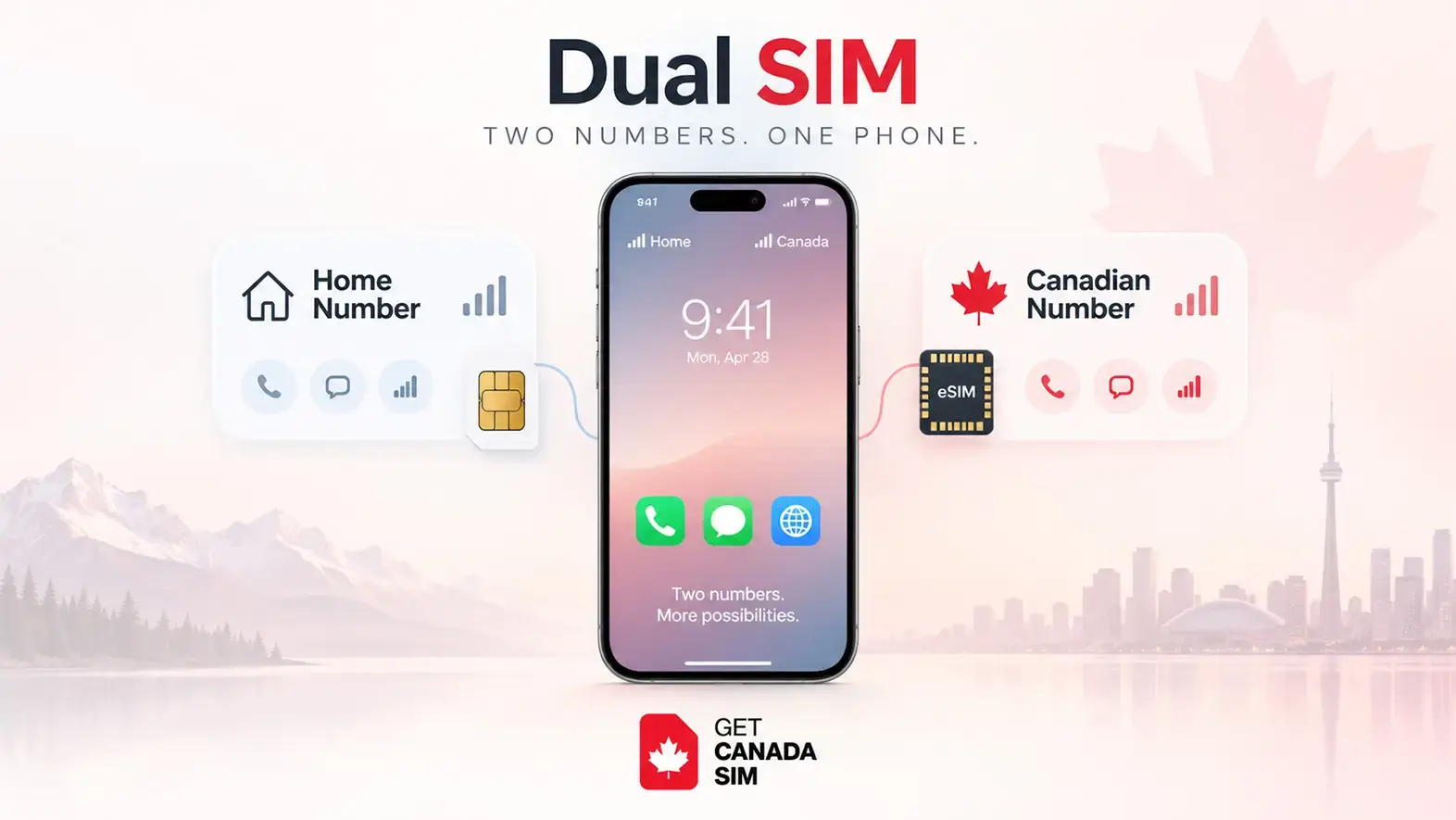
A Dual SIM phone is a phone that can use two mobile lines on the same device. Depending on the phone, those two lines may come from two physical SIM cards, one physical SIM plus one eSIM, or two eSIMs.
For example, you could keep your regular home-country number active while adding a second number for travel, work, or another country. You can then choose which line you want to use for calls, texts, and mobile data.
Dual SIM does not necessarily mean both SIMs are doing everything at the same time. How the two lines behave depends on your phone and the type of Dual SIM technology it uses.
If eSIM itself is new to you, start with what an eSIM is and how it works in Canada. It explains the digital SIM separately before you get into using two lines together.
Key takeaways
- A Dual SIM phone can keep two mobile lines on one device.
- The two lines can be physical SIMs, eSIMs, or a combination of both.
- You can usually choose which number handles calls, texts, and mobile data.
- Many phones keep both lines ready to receive calls, but some functions may be limited while one line is already in use.
- Dual SIM is useful for travel, keeping personal and work numbers separate, or maintaining a home number alongside another country's number.
- Before relying on it, check the exact phone model, because Dual SIM support varies by device and region.
What is a Dual SIM phone?
A Dual SIM phone is simply a smartphone that can have two SIM lines configured at the same time.
Each SIM line can have its own:
- phone number,
- mobile plan,
- carrier,
- calling allowance,
- text allowance,
- and mobile data service.
The phone then lets you decide how those two lines should be used.
For example:
SIM 1: Your personal number | SIM 2: Your work number
Or:
SIM 1: Your home-country number | SIM 2: Your Canadian number
Or:
SIM 1: Your normal mobile plan | SIM 2: A temporary travel eSIM
This is why Dual SIM is especially useful for people who travel, work internationally, or do not want to carry two phones.
How does Dual SIM work?
A Dual SIM phone stores information for two mobile lines and connects those lines to available cellular networks.
In your phone's settings, the two lines may appear with labels such as:
- Primary
- Secondary
- Personal
- Business
- Travel
- Home
- Canada
You can usually rename them yourself.
The phone then allows you to choose which line should be used for different tasks.
| Function | Example choice |
|---|---|
| Calls | Canadian SIM |
| SMS/texts | Canadian SIM |
| Mobile data | Canadian SIM |
| Existing home number | Keep active for incoming calls/texts |
You do not normally combine the data allowance or calling allowance from both plans. They remain two separate mobile services even though they are inside the same phone.
What are the different types of Dual SIM?
Dual SIM does not always mean two plastic SIM cards.
Modern phones can support Dual SIM in several different ways.
Two physical SIM cards
The phone has room for two physical SIM cards.
A physical SIM card is the removable card inserted into a phone's SIM tray. If a phone has two compatible physical SIM slots, it can use two physical mobile lines.
This setup is still available on some Android phones and certain regional phone models.
One physical SIM + one eSIM
This is one of the most common modern Dual SIM setups.
You keep one physical SIM in the phone and add another line digitally through an eSIM.
An eSIM is an embedded SIM built into the device rather than a removable card.
This can be useful for travellers because you can keep your existing physical SIM installed while adding another mobile plan digitally.
If you're deciding between the two formats themselves, see our guide to eSIM vs physical SIM for newcomers to Canada.
Two eSIMs
Some newer phones can keep two eSIM lines active at the same time.
This means you may be able to use two numbers without having any physical SIM inserted.
However, the exact number of eSIM profiles a phone can store and the number it can keep active simultaneously are not always the same.
Always check your exact device.
What is Dual SIM Dual Standby?
You may see the term Dual SIM Dual Standby, often shortened to DSDS.
This means both SIM lines can usually remain registered with their networks while the phone is waiting.
So, for example:
- someone can call your first number,
- someone else can call your second number,
- and both lines remain available while the phone is idle.
However, when you're actively using one line for a call, the other line may become temporarily unavailable on some devices.
This behaviour varies by phone, network, Wi-Fi Calling support, and how the manufacturer has implemented Dual SIM.
The important point is:
Dual Standby means both lines can wait for communication, but it does not always mean both can handle active calls simultaneously.
What is Dual SIM Dual Active?
Dual SIM Dual Active, sometimes called DSDA, is a more advanced configuration.
It allows both lines to remain active more independently, including in situations where one line is already being used.
This is less common than Dual SIM Dual Standby.
For most users, the difference only becomes noticeable when they are:
- already on a call,
- expecting calls on both numbers,
- or relying heavily on two separate lines at the same time.
You usually do not need to choose a phone based only on DSDS versus DSDA unless this behaviour is important to how you use the device.
Can both SIMs receive calls?
Usually, both configured lines can receive calls while the phone is idle.
For example, if your phone has:
Line 1: +1 Canadian number Line 2: Your original home number
a caller can dial either number.
Your phone will normally show which line is receiving the call.
However, what happens to the second line while you are already talking on the first line depends on your phone, network, and Dual SIM implementation.
On some phones, the second line may temporarily be unavailable. On others, features such as Wi-Fi Calling or more advanced Dual SIM support may change the behaviour.
So if receiving calls on both numbers at all times is important, check your phone manufacturer's documentation rather than assuming all Dual SIM phones work identically.
How do calls work on a Dual SIM phone?
When you make a call, the phone usually gives you several options.
You may be able to:
- set one SIM as the default for all outgoing calls,
- choose the SIM each time you call,
- or let the phone remember which SIM you previously used for a particular contact.
For example:
Canadian contacts → Canadian number
Family at home → Home SIM
This can make Dual SIM feel almost automatic after you have configured it.
The person receiving your call normally sees the phone number of whichever line you used.
How do text messages work with Dual SIM?
SMS messages work in a similar way.
Each SIM has its own phone number, so messages sent to either number can arrive on the same phone.
When sending a new message, the phone may let you choose which line to use.
Some phones also remember the line previously used for a conversation.
It is worth checking the selected line before sending an important text, especially when one SIM has international texting charges.
How does mobile data work with Dual SIM?
This is one of the most important things to understand.
Even though two SIM lines may be active, most Dual SIM phones normally use one selected line for cellular data at a time.
For example:
Home SIM Calls and texts
Canadian SIM Mobile data
You can normally change the preferred data SIM from your phone settings.
Some phones also offer features that automatically switch mobile data between lines under certain conditions.
But don't assume your phone will always choose the cheapest option automatically.
Before travelling, check which SIM is selected for mobile data.
Can both SIMs use mobile data at the same time?
Usually, you choose one line as the primary mobile-data line.
Both lines may remain available for calls and texts, but the phone does not normally merge the two plans into one larger data connection.
For example, having:
- 20 GB on SIM 1
- 50 GB on SIM 2
does not normally create a single 70 GB allowance.
They remain separate plans.
You can switch which SIM supplies mobile data when needed.
Does your phone support Dual SIM?
Not every phone supports the same type of Dual SIM.
Even phones with the same marketing name can sometimes have different SIM configurations depending on where they were originally sold.
Before relying on Dual SIM, check:
- Your exact phone model.
- Whether it supports two physical SIMs, physical SIM + eSIM, or two eSIMs.
- How many lines can be active simultaneously.
- Whether your carrier supports the phone's eSIM features.
- Whether the phone is unlocked if you want to use another carrier.
If your second line will be an eSIM, start with our guide on how to know if your phone supports eSIM.
You can also check the broader eSIM-compatible devices list for iPhone, Samsung Galaxy, Google Pixel, Xiaomi, and other supported devices.
Compatibility and carrier locking are separate issues. A phone may technically support Dual SIM but still reject another carrier's line if it is locked. If you're travelling, check how to tell whether your phone is locked and unlock it before Canada.
Physical SIM + eSIM vs two eSIMs
Neither setup is automatically better.
The better option depends on your phone and how you use it.
| Setup | Useful when |
|---|---|
| Two physical SIMs | You want removable cards and your phone supports two SIM slots |
| Physical SIM + eSIM | You want to keep an existing SIM while adding a digital second line |
| Two eSIMs | You prefer an entirely digital setup and your phone supports two active eSIMs |
A physical SIM can be convenient if you regularly move your number to another phone.
An eSIM can be convenient if you want to add another line without removing your existing card.
For many travellers, physical home SIM + destination eSIM is a practical setup because it lets them keep their original SIM installed.
But there is no universal best arrangement.
Also remember that SIM configurations increasingly vary by phone and region. Some devices may rely entirely on eSIM rather than offering a physical SIM tray.
Is Dual SIM useful for travel?
Yes, this is one of its most practical uses.
Suppose you normally live in another country but are travelling to Canada.
You could keep:
Home SIM: your existing number Canadian SIM/eSIM: Canadian mobile service
This lets you keep access to your existing number while using another line for local communication and data.
If you're still deciding whether you actually need an eSIM for your trip, the guide Do I Need an eSIM in Canada? compares the decision for different types of travellers.
And if having a local phone number matters, remember that not every travel eSIM provides one. Our guide to Canadian eSIMs with a local phone number explains the difference between data-only eSIMs and mobile plans that include a Canadian number.
However, you still need to understand your home carrier's roaming rules.
Simply keeping a SIM inside a Dual SIM phone does not automatically prevent roaming charges.
Does Dual SIM prevent roaming charges?
No.
Dual SIM gives you more control over which line you use, but it does not automatically disable roaming.
For example, if your home SIM is still allowed to use mobile data while you are abroad, it may connect to a roaming network.
A common travel setup is:
Home SIM
- Keep number available where appropriate
- Mobile data roaming off
Local or Canadian SIM
- Calls/texts according to plan
- Mobile data on
The exact settings and charges depend on your carriers.
This is why you should review roaming settings before travelling rather than assuming Dual SIM alone protects you from extra costs.
Does Dual SIM use more battery?
Using two active lines can increase battery use somewhat because the phone may need to maintain connections with two mobile networks.
How noticeable this is depends on factors such as:
- signal strength,
- network technology,
- how frequently each SIM is used,
- background network activity,
- and the phone itself.
Weak signal can have a particularly noticeable effect because the phone may work harder to maintain a network connection.
For most users, Dual SIM does not mean the battery suddenly drains twice as fast.
Can you use two WhatsApp accounts because you have Dual SIM?
Having two SIMs means you can have two phone numbers, but it does not automatically mean every app gives you two accounts.
WhatsApp account support depends on WhatsApp's own features and your device.
On supported setups, you may be able to use more than one WhatsApp account, but that is separate from the Dual SIM technology itself.
Dual SIM simply provides the phone numbers. The app decides how many accounts you can configure.
If you're mainly wondering what happens to your existing account after moving, read how WhatsApp works in Canada without changing to a Canadian number.
Can you turn one SIM off temporarily?
Yes, on many Dual SIM phones you can disable one line from the phone's SIM settings without physically removing it.
This can be useful when:
- travelling,
- avoiding accidental roaming,
- taking time away from a work number,
- troubleshooting a network problem,
- or temporarily using only one mobile service.
You can normally turn the line back on later.
Do not delete an eSIM profile simply because you want to stop using it temporarily. Disabling the line and deleting the eSIM are different actions.
What happens if you remove or delete one SIM?
For a physical SIM, removing the card simply removes that line from the phone until you insert it again.
For an eSIM, deleting the profile can be more important.
You may need your carrier's help, a replacement QR code, or another activation method to reinstall it.
So if you're troubleshooting:
Turn the eSIM line off first rather than deleting it unless your provider specifically tells you to remove it.
If you use an iPhone, our eSIM activation and troubleshooting guide for iPhone covers installation, transfer, activation problems, and what to check before deleting an eSIM.
When is a Dual SIM phone useful?
Dual SIM can make sense if you:
- travel internationally,
- live between two countries,
- want separate personal and work numbers,
- want to keep an old number while trying a new carrier,
- use one provider for calls and another for data,
- or want to keep your home number while adding a local number abroad.
It is less important if you use only one number and one mobile plan.
There is no need to use both SIM capabilities simply because your phone supports them.
Using Dual SIM with a home number and Canadian number
If you're specifically moving or travelling to Canada, the technical explanation above is only the first part.
You will also need to decide:
- which line should handle mobile data,
- whether your home SIM should remain active,
- how to reduce accidental roaming,
- which number to use for Canadian calls,
- and how to configure the phone after your Canadian line is added.
We cover those Canada-specific decisions separately in How to Use Dual SIM in Canada.
If you have not chosen the Canadian line yet, you can also read how to buy a Canadian SIM card before you land to understand the difference between arranging an eSIM and a physical SIM before your trip.
Keeping those instructions separate means this article can explain what Dual SIM is, while the Canada guide shows you how to actually use it after adding a Canadian line.
FAQ
What does Dual SIM mean?
Dual SIM means a phone can have two mobile lines configured on the same device. The lines can come from physical SIM cards, eSIMs, or a combination of both.
Does Dual SIM mean two phone numbers?
Usually, yes. Each mobile line normally has its own phone number and plan.
Can I have two different carriers on a Dual SIM phone?
Often, yes, provided the phone is unlocked and both carriers are compatible with the device.
Can both SIMs be active at once?
Many Dual SIM phones can keep both lines available while idle. Exactly what happens when one line is already being used depends on the phone's Dual SIM technology and carrier support.
Can I choose which SIM uses data?
Yes, Dual SIM phones generally allow you to select a preferred mobile-data line.
Can I choose which SIM makes calls?
Yes. You can usually set a default line, choose manually, or sometimes assign preferred lines to individual contacts.
Can I receive texts on both numbers?
Usually, yes, while both lines are enabled and connected to their networks.
Can I use one physical SIM and one eSIM?
Many modern phones support this combination. Check the exact model because regional versions can differ.
Can I use two eSIMs at once?
Some newer phones support two active eSIMs, but this is device-specific.
Does Dual SIM make the internet faster?
Not normally. Dual SIM does not automatically combine the data connections from two carriers to increase speed.
Do I need Dual SIM to use eSIM?
No. A phone can support eSIM without you using two lines. Dual SIM simply means the device can use two mobile lines.
Is Dual SIM worth using?
It is useful when you genuinely need two numbers or two mobile services. If you only need one line, there is no particular reason to activate a second SIM. You can check more on VirginPlus.
The simple way to understand Dual SIM
A Dual SIM phone gives you two mobile lines on one device.
The easiest way to think about it is:
Two numbers, two plans, one phone.
You decide which line handles calls, messages, and mobile data.
The most important thing is not whether your phone says “Dual SIM” on the box. It is understanding which type of Dual SIM your exact model supports and whether that setup matches what you want to do.
If your goal is keeping your existing number while adding Canadian service, the Canada-specific Dual SIM guide linked above is the logical next step.
Follow Get Canada Sim on Google
Make Get Canada Sim a preferred source to find our latest Canada SIM and eSIM guides in Google Search.