

Canadian Area Codes Explained: A Newcomer's Guide
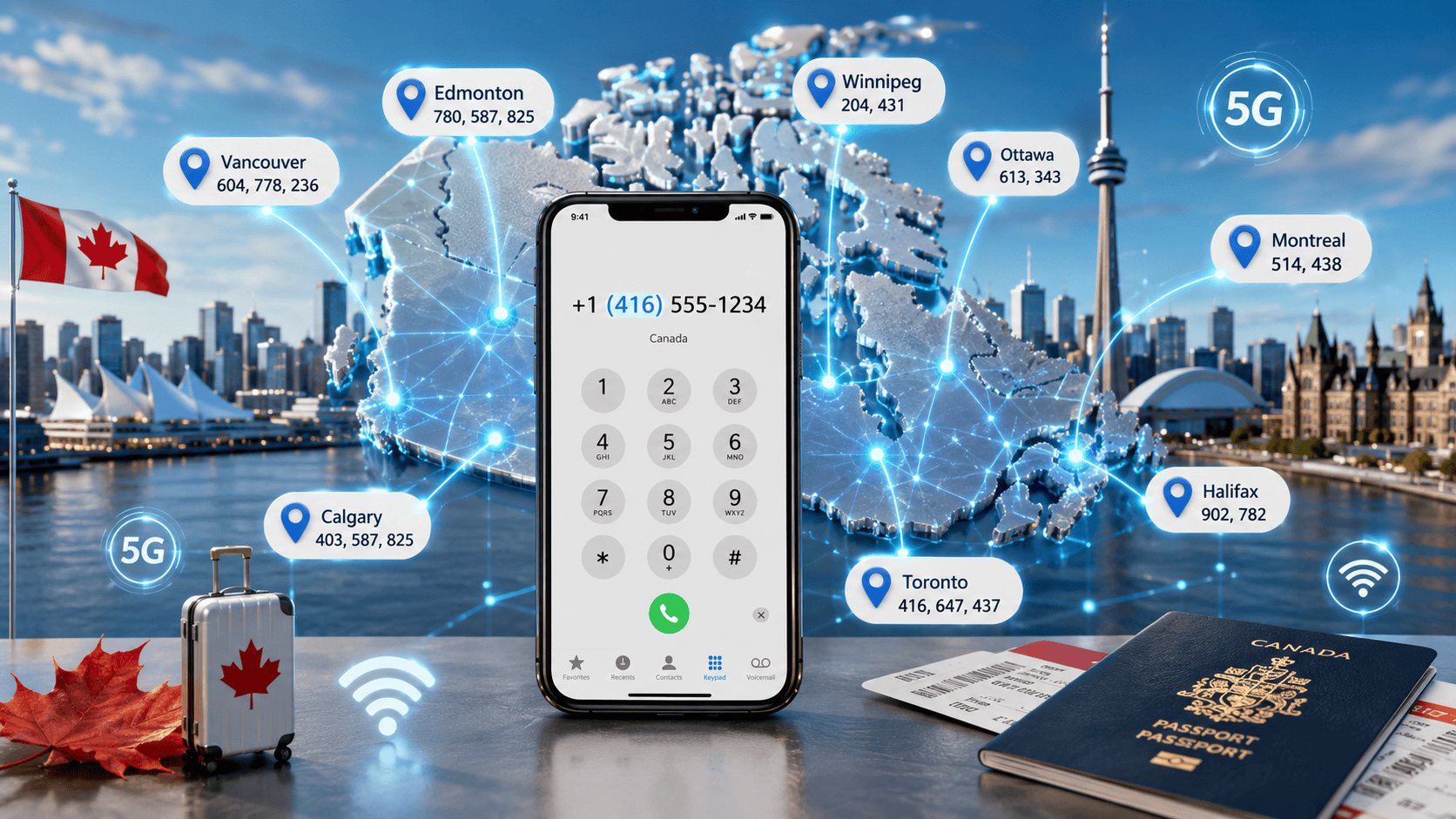
Canadian area codes are the first three digits of a phone number, and they tell you which region a number is linked to. For example, 416 covers Toronto, 604 covers Vancouver, and 514 covers Montreal. Canada uses the same 10-digit format as the United States, so every number has a 3-digit area code plus a 7-digit local number.
This guide breaks down Canadian area codes for newcomers: what they mean, which code goes with which region, and whether the code you get actually matters.
Key takeaways
- A Canadian area code is the first 3 digits of a phone number and points to a region.
- Big cities often have several area codes because demand grew over time.
- You usually can't pick your exact area code, but you can often get one for your region.
- Your area code doesn't limit where your phone works. It works across Canada.
- Calls within Canada are dialled as 10 digits (area code + number), often with a 1 in front.
What is a Canadian area code?
A Canadian area code is the three-digit prefix at the start of a phone number that ties the number to a geographic region. Canada is part of the North American Numbering Plan, the same system the U.S. uses, so numbers follow the format (XXX) XXX-XXXX.
When you get a Canadian number, it comes with an area code based on the region it's issued in. That code stays with the number even if you travel, so a Toronto number still works in Vancouver.
If you don't have a Canadian number yet, our guide on how to get a Canadian phone number before you land explains your options.
Which area code belongs to which region?
Each area code maps to a province or city region. Major cities often have more than one code because they ran out of numbers as they grew. Here are some of the most common Canadian area codes and where they're used.
| Region / City | Common area codes |
|---|---|
| Toronto, ON | 416, 647, 437 |
| Greater Toronto Area | 905, 289, 365 |
| Vancouver, BC | 604, 778, 236 |
| Montreal, QC | 514, 438 |
| Calgary, AB | 403, 587, 825 |
| Edmonton, AB | 780, 587, 825 |
| Ottawa, ON | 613, 343 |
| Winnipeg, MB | 204, 431 |
| Halifax, NS | 902, 782 |
This isn't a full list, and codes get added over time. If you're unsure about a specific code, the official numbering administrator keeps an up-to-date list.
Why do big cities have several area codes?
Big cities have multiple area codes because they ran out of available numbers under a single code. When that happens, a new code is added on top of the existing one, a system called an overlay. Toronto is a good example, with 416, 647, and 437 all serving the same area.
Because of overlays, two neighbours can have different area codes. That's normal, and it doesn't change how the phones work or what calls cost within the city.
Does your area code matter when you move?
For most day-to-day use, your area code doesn't limit anything. Your phone works across Canada no matter which code you have. A 604 number works fine in Toronto, and a 416 number works fine in Calgary.
Where an area code can help a little is first impressions. A local-looking number can feel familiar to landlords, employers, or local contacts. It's a nice-to-have, not a requirement. For why a local number can still be handy, see our guide on renting in Canada and why a local phone number helps.
How do you dial numbers in Canada?
You dial 10 digits: the area code plus the 7-digit local number. In many areas you also add a 1 in front, so it looks like 1 (XXX) XXX-XXXX. Because of overlays, 10-digit dialling is standard even for local calls.
For international calls into Canada, callers use their country's exit code, then 1, then the area code and number. If you plan to call family abroad, see our guide to the best ways to call home from Canada.
FAQ
Can I choose my own area code in Canada?
Not exactly. You usually can't pick a specific area code, but many providers can give you a number in your region if codes are available there. Since big cities use overlays, you might get any of the local codes. If a regional number matters to you, ask your provider before you sign up.
Does my area code change if I move within Canada?
No. Your number and area code stay the same when you move, even to another province. There's no need to change your number just because you relocate. If you'd prefer a local code in your new city, you'd have to get a new number rather than change the existing one.
Do calls cost more between different area codes?
Not usually. Within Canada, calling another province is generally treated the same as a local call on most modern plans, though this depends on your plan's terms. Get Canada Sim plans include unlimited Canada-wide calling, so reaching a different area code within Canada costs nothing extra. Always check your plan details for any long-distance conditions.
What area code will I get if I buy a Canadian number online?
It depends on availability and the region tied to your plan. You may not get to choose the exact code, but it will be a valid Canadian number that works nationwide. If a specific region matters, ask before buying. You can compare plans to see what's offered.
Is a 1 always needed before a Canadian number?
Often, yes. Canada uses 10-digit dialling, and many areas require a 1 before the area code for calls. When saving contacts, it's safest to store numbers in full international format (+1 then the 10 digits) so they work from anywhere.
New to Canadian numbers? Compare plans to get set up, or see how it works before you arrive.
For the official, current list of codes, see the Canadian Numbering Administrator's area code resources.
Follow Get Canada Sim on Google
Make Get Canada Sim a preferred source to find our latest Canada SIM and eSIM guides in Google Search.