

Best Ways to Call Home from Canada: International Calling Compared
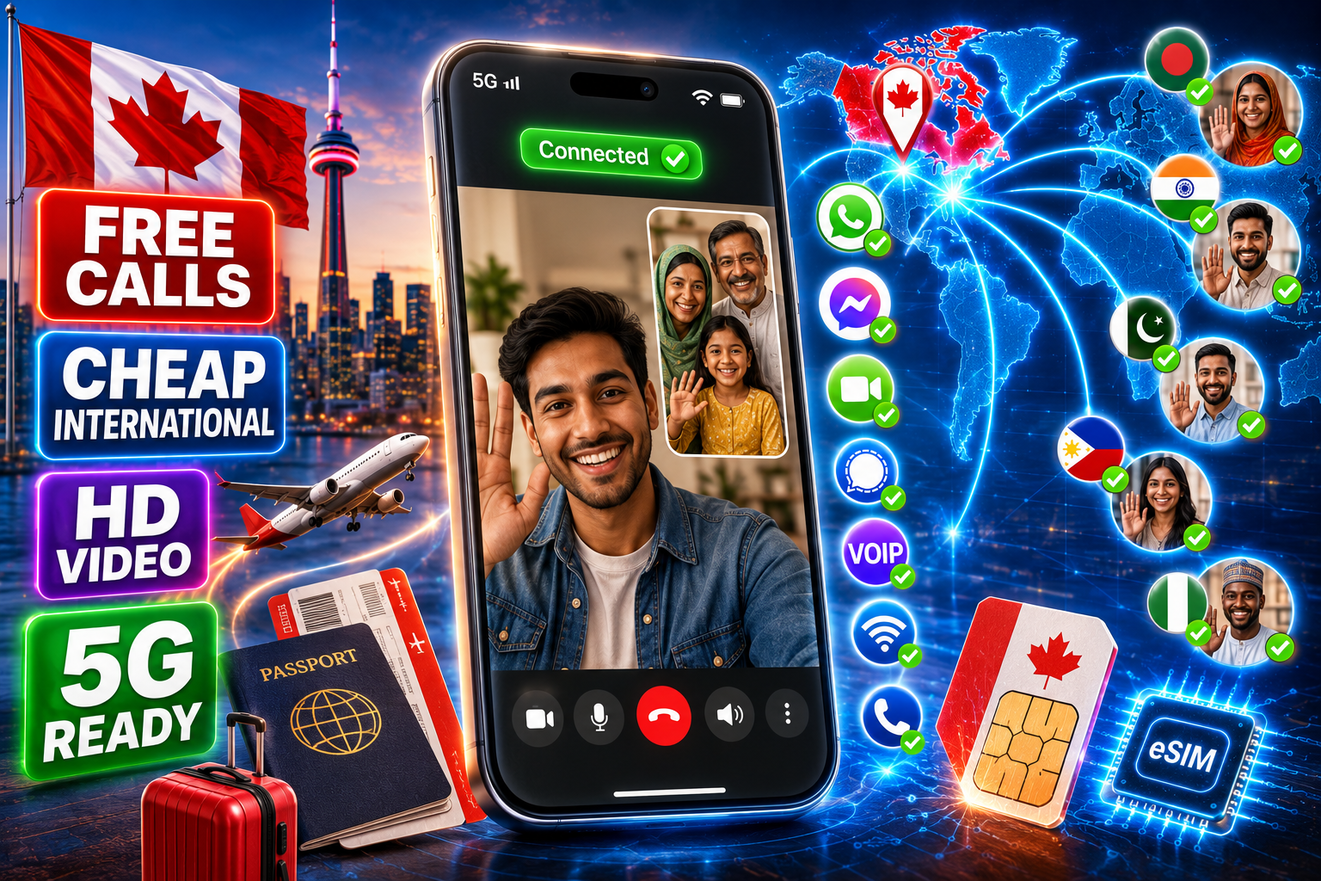
The best way to call home from Canada for most people is a free internet app like WhatsApp over Wi-Fi or data. If you need to reach a landline or someone without the same app, a cheap VoIP service or an international calling add-on on your SIM works better. The right pick depends on who you're calling and whether they use apps too.
If international calling is an important part of how you will use your phone, include it when deciding how to choose a phone plan in Canada. A plan with lots of data may suit frequent WhatsApp or video calls, while someone regularly dialling overseas phone numbers may care more about international minutes and per-minute rates.
Quick note: VoIP means "voice over internet protocol" — calls carried over the internet instead of the traditional phone network, usually at lower rates than conventional international calling.
Key takeaways
- App-to-app calls such as WhatsApp, Messenger, FaceTime, and Signal use Wi-Fi or mobile data rather than traditional international calling minutes.
- To call a landline or mobile number directly, VoIP credit or an international calling option may cost less than your carrier's standard international rate.
- Long video calls use considerably more data than voice calls.
- Check exactly which countries and minutes an international add-on includes before relying on it.
- If you keep your home SIM active in Canada, check its roaming charges and settings.
- A Canadian mobile-data connection can keep internet-based calls working when you are away from Wi-Fi.
Which way should you call home from Canada?
Start with the person you are trying to reach.
If they already use WhatsApp, FaceTime, Messenger, Signal, or another internet calling app, an app-to-app call is usually the simplest option. You do not need to dial an international number or buy international calling minutes.
You can also continue using an existing WhatsApp account after arriving in Canada. Our guide to using WhatsApp in Canada without a Canadian number explains how the account, your existing number, Wi-Fi, and Canadian mobile data work together.
If the person only has a regular mobile number or landline, however, you need a different solution.
| Your situation | Usually the simplest option | What to check |
|---|---|---|
| Both people use the same calling app | App-to-app call | Wi-Fi or mobile data |
| Calling parents or relatives on a landline | VoIP or international calling option | Destination rate |
| Regular overseas phone-number calls | International add-on or VoIP | Included countries and minutes |
| One occasional international call | Compare direct dialling and VoIP | Per-minute charge |
| Long family video calls | App over Wi-Fi | Connection quality |
| Keeping your home number active | Dual SIM | Roaming charges |
| Calling while travelling around Canada | App over Canadian mobile data | Data allowance |
The important question is therefore not simply “Which international calling service is cheapest?”
It is:
Who am I calling, and can that person receive an internet call?
What is the cheapest way to call home from Canada?
When both people have internet access and use the same app, an internet-based voice call can avoid traditional international calling charges.
Apps such as WhatsApp, Signal, FaceTime, and Messenger use your internet connection instead of placing a conventional international call through the mobile voice network.
That means you are using:
Wi-Fi → no mobile-data usage
or
Mobile data → usage comes from your data allowance
For families who regularly talk for long periods, this can make a major difference.
For example, if you make daily WhatsApp calls while commuting, your Canadian data allowance becomes more relevant than an international voice package. If you mostly call from home over Wi-Fi, you may need much less mobile data.
That is why data requirements should be considered alongside calling habits rather than separately.
For someone preparing to move to Canada, this is also one reason not to buy the largest mobile package automatically. Think about where you will actually have Wi-Fi and where you will rely on your phone's connection.
How do I call a landline or non-app number back home?
A calling app is less useful when the person you need to reach does not use the same app.
For example, you may need to call:
- a parent's landline,
- an overseas business,
- a government office,
- a hotel,
- a mobile number belonging to someone without internet access,
- or another regular telephone number.
In these situations, common options include a VoIP calling service, an international calling add-on, a calling card, or direct international dialling.
| Method | Best for | Keep in mind |
|---|---|---|
| Calling apps | Both people use the same app | Internet required |
| VoIP credit service | Calling overseas phone numbers | Country rates vary |
| International mobile-plan feature | Regular overseas calls | Check included destinations |
| Calling card | Particular countries or landlines | Check fees and expiry |
| Standard international dialling | Infrequent calls | May have higher rates |
If you expect to make traditional international calls regularly, review the calling inclusions when you compare current Canada SIM plans rather than comparing plans only by data allowance.
Don't assume “international calling included” covers every country
International calling benefits can have conditions.
A plan might include:
- only certain countries,
- a specific number of minutes,
- different mobile and landline rates,
- different rates after included minutes are used,
- or no international calling at all.
So if most of your calls go to Bangladesh, India, the Philippines, Nigeria, China, the UK, or another specific country, check that destination rather than assuming the words international calling cover it.
How do I dial an international number from Canada?
For many international calls, the basic format is:
+ country code + phone number
You may need to remove a domestic prefix from the beginning of the local number.
For example, a Bangladeshi mobile number written locally as:
017XX XXX XXX
is generally written internationally using Bangladesh's +880 country code:
+880 17XX XXX XXX
The exact format depends on the country you are calling.
Saving overseas contacts in international +country code format is also useful if you travel between countries because you do not need to rewrite the contact each time.
Should I use Wi-Fi or mobile data for calls?
Use Wi-Fi when it is reliable, particularly for long video calls. Use mobile data when you are away from Wi-Fi.
For example:
At home: Wi-Fi → WhatsApp video call
On the bus: Canadian mobile data → WhatsApp voice call
Walking around the city: Canadian mobile data → Messenger or Signal
Calling an overseas landline: VoIP or international mobile calling
Voice calls generally consume much less data than video calls, so switching from video to voice can help when you are away from Wi-Fi.
If you want your Canadian mobile connection prepared before travel, see how Get Canada SIM setup works before arrival.
App calls over Wi-Fi and carrier “Wi-Fi Calling” are different
These terms sound similar but describe different things.
A WhatsApp call over Wi-Fi happens inside WhatsApp and travels over the internet.
Wi-Fi Calling is a mobile-carrier feature that can route normal calls from your regular phone number through Wi-Fi when cellular coverage is limited.
Connecting your phone to Wi-Fi therefore does not automatically make a normal international phone call free.
Your carrier's international calling rules can still apply.
What about calling cards?
Calling cards are still available and can make sense for people who frequently call a particular overseas country or landline.
Depending on the service, you typically:
- Call an access number.
- Enter a PIN or account number.
- Enter the overseas number.
- Pay according to the service's international rate.
Do not compare calling cards using the advertised per-minute price alone.
Check:
- connection fees,
- minimum call duration,
- call rounding,
- expiry dates,
- mobile versus landline rates,
- account-maintenance charges,
- and the rate for your specific destination.
For smartphone-to-smartphone family calls, an internet app is generally simpler.
Does calling home use a lot of mobile data?
It depends mostly on whether you make voice or video calls.
Voice: relatively light data usage.
Video: considerably heavier data usage because your phone continually sends and receives video.
That means someone who spends two hours every evening on family video calls should think differently about mobile data than someone who makes a ten-minute WhatsApp voice call each day.
If you have Wi-Fi at home, university, or work, those calls may barely affect your mobile allowance.
Someone without reliable Wi-Fi during their first weeks in Canada may need considerably more mobile data.
Do I need a Canadian number to call home?
No.
You can make WhatsApp, Signal, Messenger, FaceTime, and similar internet calls using Wi-Fi without having a Canadian phone number.
A Canadian number and mobile plan become useful for other reasons, including having mobile data when you leave Wi-Fi and making or receiving regular Canadian calls and texts.
You can also keep your existing home-country number and add another line if your phone supports it.
Our guide to using Dual SIM in Canada with a home number and Canadian number explains how to divide calls, texts, and mobile data between the two lines.
Can I keep my home SIM active while using Canadian data?
Yes, on a compatible Dual SIM phone.
A common configuration looks like this:
| Home-country SIM | Canadian SIM/eSIM |
|---|---|
| Keep your existing number | Canadian mobile connection |
| Receive important calls/texts if your carrier allows | Mobile data |
| Data roaming off | Local calls |
| Check roaming charges | Primary data line |
If Dual SIM terminology itself is unfamiliar, read what Dual SIM is and how it works before changing the settings.
The most important detail is roaming.
Leaving your home SIM in the phone does not itself make every service free. Your home carrier may charge for calls, texts, or data used while the line is connected in Canada.
The Canadian Radio-television and Telecommunications Commission explains how mobile roaming fees can apply while travelling and recommends checking your carrier's roaming options and device settings before relying on your home service abroad. CRTC guidance on international roaming fees
Turning off data roaming on your home line can help prevent that SIM from using mobile data in the background.
What's the best setup if you call home every day?
For many people, a practical setup is:
Canadian mobile data + internet calling app + home number kept available if needed
For example:
Family uses WhatsApp
Use Canadian mobile data when away from Wi-Fi and Wi-Fi when available.
Parents only have a landline
Compare VoIP or your Canadian plan's international calling terms.
You need your old number as well
Keep both lines using Dual SIM and control which SIM handles data.
You mostly call from home
Prioritize reliable Wi-Fi rather than paying for mobile data you rarely use.
You make international business calls
Compare calling rates, destination coverage, and service reliability instead of relying only on consumer messaging apps.
The right solution can therefore be different for two people from the same country.
Before choosing how to call home
Ask yourself five questions:
- Who am I calling? An app user, mobile number, or landline?
- Which country am I calling? Traditional international rates vary by destination.
- How frequently will I call? A daily caller and an occasional caller need different options.
- Will I make voice or video calls? Video matters much more for data use.
- Will I keep my home-country SIM active? If yes, understand its roaming rules first.
Answer those questions before choosing an international calling add-on simply because it appears in a mobile-plan feature list.
FAQ
Is WhatsApp calling really free in Canada?
WhatsApp does not charge a traditional per-minute international calling rate for WhatsApp-to-WhatsApp voice or video calls.
The call uses an internet connection.
If you are connected to Wi-Fi, it does not use your Canadian mobile-data allowance. If you use mobile data, the call consumes data from that connection.
Roaming charges could still apply if the internet connection is coming from a roaming home-country SIM.
What's the cheapest way to call a landline overseas?
A VoIP service, calling card, or international mobile calling feature may offer lower rates than standard international dialling.
The cheapest option depends on the specific destination, whether you are calling a mobile or landline number, and how frequently you call.
Compare the rate to the country you actually need rather than relying on a general “cheap international calls” claim.
Will an international add-on save me money?
Possibly.
It tends to matter more when you regularly call traditional overseas phone numbers.
If almost every family conversation happens through WhatsApp or another internet calling app, paying every month for an international calling package may provide little benefit.
Check the countries, minutes, rates, and conditions before adding one.
Can I keep my home SIM for calls and use a Canadian SIM for data?
Yes, if your phone supports Dual SIM.
You can normally set the Canadian line as your mobile-data line while keeping your existing number available for calls or texts.
However, roaming charges from your home carrier may still apply when that line is used in Canada.
Does calling home use a lot of data?
Voice calls generally use much less data than video calls.
If mobile data is limited, use voice while away from Wi-Fi and save long video conversations for Wi-Fi.
Can I call internationally without a Canadian SIM?
Yes.
Internet-based calls can work over any usable Wi-Fi connection, so a Canadian SIM is not required simply to make a WhatsApp, FaceTime, Messenger, or Signal call.
A Canadian mobile connection becomes useful when you want internet access away from Wi-Fi or need Canadian mobile calling and texting.
Is Wi-Fi Calling the same as WhatsApp calling?
No.
WhatsApp calling happens inside WhatsApp using an internet connection.
Carrier Wi-Fi Calling allows compatible normal mobile calls to travel over Wi-Fi.
Your mobile provider's calling and billing rules still apply to carrier Wi-Fi Calling.
Can someone overseas call my Canadian number?
Yes, provided your Canadian service supports normal incoming calls.
For the person overseas, however, calling Canada may count as an international call under their own carrier or service.
If both people have internet access, an app-based call may avoid traditional international calling charges.
Can I receive calls on my home number while using Canadian mobile data?
Often yes on a compatible Dual SIM phone.
You can select the Canadian line for mobile data while keeping your home number active.
How calls behave depends on the device, both carriers, and your roaming setup.
Final answer
For most smartphone users, the simplest way to call home from Canada is an internet calling app when both people use the same app.
Use Wi-Fi for long calls when possible and Canadian mobile data when you are away from Wi-Fi.
If you need to call a landline or regular overseas phone number, compare VoIP and international calling options for that specific country.
And if you keep your home SIM active beside a Canadian line, configure Dual SIM and roaming carefully so your home line does not unexpectedly use expensive roaming services.
Once you know how you will actually communicate, you can compare Canada SIM and eSIM plans based on the data and calling features you genuinely need.
Follow Get Canada Sim on Google
Make Get Canada Sim a preferred source to find our latest Canada SIM and eSIM guides in Google Search.