

Rogers vs Bell vs Telus: Which Network Is Best for Newcomers?
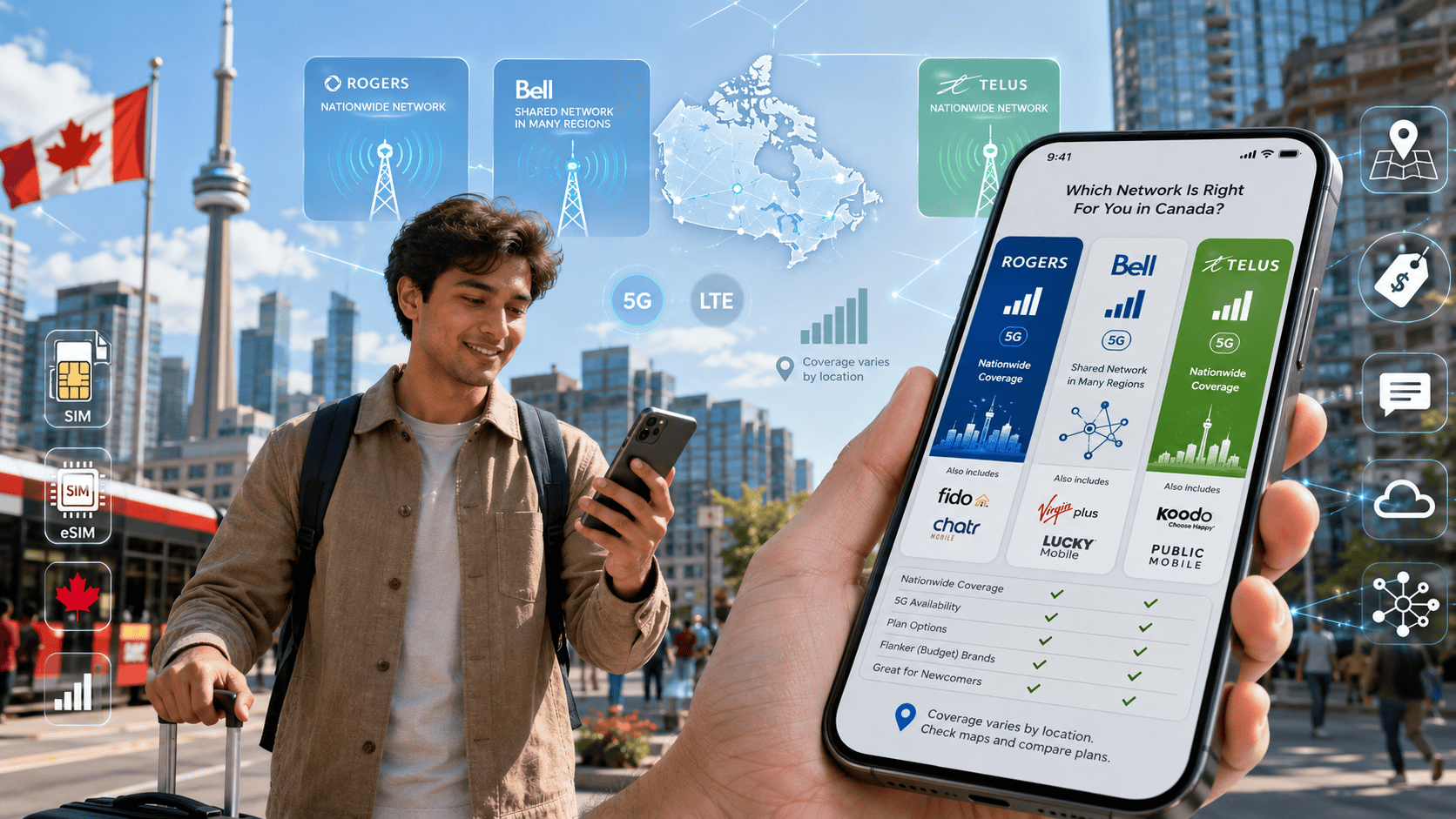
There's no single "best" network among Rogers, Bell, and Telus — each covers most populated areas of Canada well, and the right pick depends on where you'll actually live, what you're willing to pay, and whether you want a flanker brand that rides the same towers for less money.
If you are already deciding between carriers, you can also compare current Canada SIM plans to see how network, data allowance, price, and plan type fit together.
This guide compares the three fairly so you can match a network to your situation instead of guessing.
Key takeaways
- Rogers, Bell, and Telus are Canada's three national carriers, and each also owns budget "flanker" brands that use the same underlying network.
- Rogers owns Fido and Chatr; Telus owns Koodo and Public Mobile; Bell owns Virgin Plus and Lucky Mobile — so choosing a flanker brand often means Big Three coverage at a lower price. If those lower-cost options interest you, our guide to the best prepaid SIM cards in Canada compares the prepaid side in more detail.
- Coverage in major cities is strong across all three; differences show up more in rural, remote, and highway areas — always check a carrier's official coverage map for your specific area before deciding.
- Bell and Telus share significant network infrastructure in many regions, which can mean similar coverage from either brand in those areas.
- Price and plan structure differ more than raw coverage for most newcomers in cities — that's often the more useful comparison.
What's the actual difference between Rogers, Bell, and Telus?
The core difference is network ownership and infrastructure, though for most newcomers living in a city, the practical day-to-day experience is more similar than different. All three are full national carriers, meaning they each operate their own wireless network across Canada rather than leasing capacity from someone else. That's different from flanker and budget brands, which use one of these three networks but are sold and priced separately.
- Rogers is headquartered in Toronto and also owns Fido (mid-tier) and Chatr (budget, prepaid-focused).
- Bell is headquartered in Montreal and also owns Virgin Plus (mid-tier) and Lucky Mobile (budget, prepaid-focused).
- Telus is headquartered in Vancouver and also owns Koodo (mid-tier) and Public Mobile (budget, prepaid-focused).
That relationship matters because choosing a lower-cost brand does not necessarily mean choosing a completely different national network.
For example, someone who specifically wants a prepaid option powered by Rogers would normally compare Chatr rather than a direct Rogers prepaid plan. The Canadian prepaid SIM comparison explains that distinction in more detail.
If you are more interested in Rogers specifically, the separate guide to Rogers 5G coverage in Canada goes deeper into network coverage, 5G and what international phones need to work properly on the network.
Which network has the best coverage?
It depends on where you are. There is no single winner that is best at every address in Canada.
In major cities such as Toronto, Vancouver, Montreal and Calgary, all three networks have extensive coverage. Differences can become more noticeable along highways, in smaller communities, mountainous areas and remote locations.
But this does not mean coverage differences only matter outside cities. Buildings, underground spaces, congestion and the exact neighbourhood can affect your experience too.
If Rogers is one of the networks you are considering, read what to expect from Rogers 5G coverage across Canada before relying only on general national coverage claims.
The safest process is:
Check where you will live → check where you will work/study → check your regular travel routes → then compare price and features.
| Factor | Rogers | Bell | Telus |
|---|---|---|---|
| Network type | Independent national network | National network, shares infrastructure with Telus in parts of Canada | National network, shares infrastructure with Bell in parts of Canada |
| Flanker (mid-tier) brand | Fido | Virgin Plus | Koodo |
| Budget/prepaid brand | Chatr | Lucky Mobile | Public Mobile |
| Best way to check your coverage | Official Rogers coverage map | Official Bell coverage map | Official Telus coverage map |
| Urban coverage | Generally strong | Generally strong | Generally strong |
| Rural/remote coverage | Varies by region — check map | Varies by region — check map | Varies by region — check map |
Should newcomers choose a Big Three carrier or a flanker brand?
Most newcomers are better served by a flanker or budget brand, because you get the same underlying network at a lower price, as long as the specific plan features match your needs. Fido, Virgin Plus, and Koodo generally offer more plan flexibility and customer service resources than the budget brands, while Chatr, Lucky Mobile, and Public Mobile tend to be simpler, prepaid-first, and cheaper, sometimes with fewer perks like device financing or family plans.
If you specifically need postpaid billing, device financing, or premium add-ons (international roaming bundles, for example), a direct Big Three plan or a flanker brand is more likely to offer that structure. If you mainly need reliable calling, texting, and data without frills, a budget brand riding the same network can be a genuinely good value — you're not sacrificing coverage, just extras.
How do I decide which network to use as a newcomer?
Start with where you'll actually be living and commuting, not with brand reputation. A practical decision process:
- Identify your city, neighbourhood, and regular commute or travel routes.
- Check the official coverage map for Rogers, Bell, and Telus (or their flanker brands) for those specific locations.
- Compare plan pricing and inclusions for the brands with acceptable coverage in your area — see current plans for a starting point on what to look for.
- Consider whether you want a physical SIM or an eSIM, and whether the carrier supports pre-arrival activation.
- Factor in customer service language support and store locations near you, if in-person help matters to you.
- Make your decision based on the combination of coverage, price, and plan features — not brand name alone.
Does it matter which network I pick if I travel outside cities often?
Yes, more than it matters for city-only living. If you expect to drive between provinces, visit national parks, or live somewhere outside a major metro area, coverage gaps become more noticeable, and the "best" network can genuinely differ by route or region. For example, coverage along a highway between two cities might favor one carrier over another even if both are equally strong within each city itself. If this applies to you, check our guide on cell coverage in rural and park areas before committing to a plan, and prioritize a carrier whose map shows strong coverage specifically on the routes you'll use most.
What about 5G availability across the three networks?
All three carriers have been expanding 5G, Canada's newest generation of mobile network technology built for faster speeds and lower lag than 4G/LTE, but availability still varies by neighbourhood and city, so it's not a given everywhere yet. If 5G speed matters to you specifically — for example, if you work from home and rely on your phone as backup internet — check each carrier's 5G coverage map for your address rather than assuming a blanket rollout. In practice, most everyday phone use (calls, texts, browsing, streaming, video calls) works fine on strong 4G/LTE too, so 5G availability is a nice-to-have for most newcomers rather than a deciding factor.
Does customer service or language support differ between carriers?
It can, and this is worth considering if you'd rather resolve issues in your first language or prefer in-person help over phone support. The Big Three generally maintain more physical retail stores and broader multilingual support lines than their budget flanker brands, which often operate primarily online or by phone/chat to keep costs down. If you expect to need in-person help — activating a new SIM, troubleshooting a device, or resolving a billing issue face-to-face — factor store locations near your home or workplace into your decision, not just price and coverage. If you're comfortable managing your account online and troubleshooting over chat, a budget brand's lighter support model may not matter much to you.
How does a reseller SIM or eSIM fit into this comparison?
Providers like Get Canada SIM don't operate their own towers — they typically resell access to one of these underlying networks, which means the coverage question above still applies to you even when buying from a reseller. The main advantage of going through a reseller before you arrive is convenience: pre-arrival ordering, activation support, and a Canadian number ready before you land, rather than navigating a Big Three or flanker brand's sign-up process cold on arrival day. Either way, the coverage fundamentals — check the map for your specific address — apply no matter which brand name is on the SIM.
FAQ
Is Rogers, Bell, or Telus objectively the best network in Canada? No single carrier is best for everyone — coverage quality depends heavily on your specific location, and all three are strong performers in most major cities with differences emerging more in rural and remote areas.
Are Fido, Virgin Plus, and Koodo the same as using Rogers, Bell, or Telus directly? Coverage-wise, yes — these flanker brands run on their parent company's network, so you get comparable coverage, typically with a different price point and plan structure than the main brand.
Do Chatr, Lucky Mobile, and Public Mobile have worse coverage than the Big Three? No, coverage is generally the same as their parent network, since these budget brands use the same towers — the difference is usually in plan features, customer service resources, and price, not raw signal.
Can I switch carriers easily if I pick wrong? Generally yes, especially with prepaid plans, which don't lock you into long contracts. You can typically switch by porting your number to a new carrier once you've decided.
How do I check coverage for my exact address before choosing? Visit the official coverage map on each carrier's website and enter your address or postal code — this is more reliable than general reputation or anecdotal reviews.
Does network choice affect eSIM compatibility? Not usually — eSIM support depends mainly on your phone model and whether it's unlocked, not which of the three networks you choose. Confirm your device is compatible before you fly by checking phone compatibility.
Ready to compare specific plans across these networks? Compare plans or see how activation works before you land.
Follow Get Canada Sim on Google
Make Get Canada Sim a preferred source to find our latest Canada SIM and eSIM guides in Google Search.