

Using a US Phone Plan in Canada: Roaming vs Buying a Local SIM
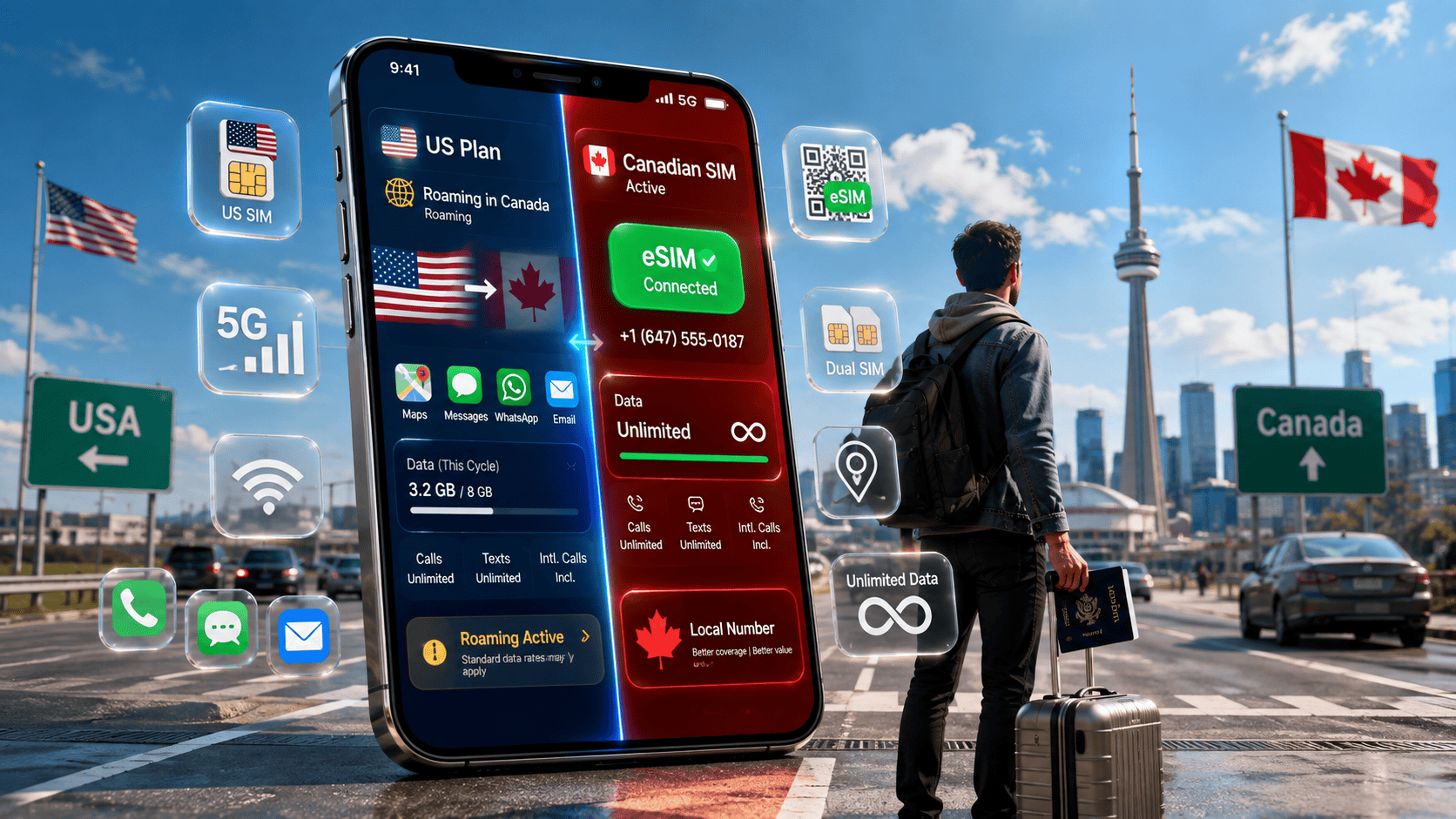
Using a US phone plan in Canada works through roaming, and many US carriers include some Canadian usage in their plans. Whether that's enough depends on how long you're staying and how much data you use. Short trips usually favour roaming. Longer stays, heavy data use, or needing a Canadian number usually favour a local SIM.
Key takeaways
- Roaming means using your US plan on a Canadian network, billed by your US carrier.
- Many US plans include some Canada usage — check your specific plan before assuming anything.
- Included Canadian data is often capped or speed-limited past a threshold.
- Roaming keeps your US number. A local SIM gives you a Canadian number, which matters for local callbacks.
- Dual SIM lets you do both at once on most modern phones.
Does your US plan already cover Canada?
Check before you do anything else — the answer changes the whole calculation.
Several major US carriers include Canada and Mexico in their plans, often described as "North America" coverage. But "included" usually comes with conditions: a data cap that's lower than your domestic allowance, reduced speeds after a threshold, or a limit on how many consecutive days you can be abroad.
Look at your plan's actual terms, not the marketing summary. The specific things to find:
- How much high-speed data you get in Canada per billing cycle.
- What happens after that — slowed, charged, or cut off.
- Whether calls and texts to Canadian numbers are included.
- Whether calls back to the US are included.
- Whether there's a limit on consecutive days of international use.
That fifth one catches long-stay travellers off guard. Some carriers reserve the right to end service for customers who use their plan primarily outside the US.
Roaming vs a local SIM: how do they compare?
| Factor | Roaming on your US plan | Canadian SIM or eSIM |
|---|---|---|
| Your US number | Keeps working | Only if you use dual SIM |
| Canadian number | No | Yes |
| Setup effort | None — it just works | Some setup required |
| Data allowance | Often capped or slowed | Set by the plan you choose |
| Cost for short trips | Often reasonable | May be more than needed |
| Cost for long stays | Can add up | Usually more economical |
| Local callbacks | Callers pay international rates | Local, straightforward |
| Speed after cap | Often heavily reduced | Depends on the plan |
Neither option is universally better. A weekend in Toronto and a four-month work term in Vancouver are genuinely different problems.
When does roaming make more sense?
Roaming usually wins when your trip is short and your usage is light.
Keep your US plan if:
- You're staying a few days to about two weeks.
- Your plan already includes Canadian data and you won't exceed it.
- You need your US number to stay reachable for work or family.
- You'd rather not deal with any setup.
- You're mostly on wifi and using data lightly.
The convenience is real. Your phone connects when you land and everything keeps working. For a short trip, that's often worth more than the savings from switching.
When does a Canadian SIM make more sense?
A local SIM usually wins when you're staying longer, using more data, or need people in Canada to reach you easily.
Get a Canadian SIM or eSIM if:
- You're staying more than a few weeks.
- You'll exceed your plan's included Canadian data.
- You're job hunting, apartment hunting, or dealing with Canadian services that call or text you.
- You need reliable data for navigation and daily life, not just occasional checking.
- Your US plan doesn't include Canada, or includes very little.
The Canadian number is the part people underestimate. Landlords, employers, delivery drivers, clinics, and service providers all call local numbers more readily than international ones. It isn't required for most of these — but it removes friction. See getting a Canadian number for your job hunt.
Can you use both at the same time?
Yes, if your phone supports dual SIM — and most modern iPhones and Android phones do.
Dual SIM means running two lines on one phone. Typically one is your physical US SIM and the other is a Canadian eSIM (a SIM built into the phone that you activate by scanning a code). You keep receiving calls and texts on your US number while using Canadian data for everything else.
The setup that works well for most people:
- Install the Canadian eSIM alongside your existing US SIM.
- Set the Canadian line as your default for mobile data.
- Keep your US line active for calls and texts, but turn off its data roaming.
- Set your default line for outgoing calls based on who you call most.
That last step matters. If you leave the US line as your calling default, you may be billed international rates for calls to Canadian numbers. Check your settings after installing the second line.
Turning off data roaming on the US line while keeping the line itself active is the key move — it prevents accidental roaming charges while keeping your number reachable.
What about calls back to the US?
Check whether your Canadian plan includes calls to US numbers. Some do, some treat them as international, and some offer them as an add-on. [VERIFY: confirm what international calling is included in the specific plan before purchase]
Alternatively, apps over wifi or data work fine for staying in touch — WhatsApp, FaceTime, Signal, and similar services don't care which country your number is from. That covers most personal calling. The gap is calls to businesses, government lines, and services that don't use apps.
Watch out for these
Automatic roaming charges. If your plan doesn't include Canada, your phone may connect and start billing the moment you cross the border. Check your settings before you travel.
Background data. App updates, photo backups, and cloud sync can burn through a roaming allowance fast. Turn off automatic updates and backups over mobile data while you're travelling.
Speed throttling. Many plans include Canadian data at reduced speeds, or reduce them after a threshold. Technically it's included; practically it might be too slow for video calls.
Emergency calls. 911 works in Canada regardless of which SIM you're using. That's not something you need to plan around.
A quick decision guide
Ask yourself three questions:
- How long am I staying? Under two weeks, lean roaming. Over a month, lean local SIM.
- How much data will I use? If you'll exceed your plan's Canadian allowance, a local plan is likely better.
- Do Canadians need to call me? If yes, get a Canadian number, either alone or via dual SIM.
If you're leaning toward a local option, compare plans and see how activation works so you know what's involved before you cross the border.
FAQ
Will my US phone work on Canadian networks?
Almost certainly, if it's a recent model. US and Canadian networks use largely overlapping technology and frequency bands, so most modern US phones work fine here. Older phones and some budget models may support fewer bands. If your phone is locked to a US carrier, you'll need it unlocked before a Canadian SIM will work.
Do I get charged for incoming calls while roaming in Canada?
It depends on your plan. Some North America plans include incoming calls in Canada at no extra cost; others charge for them. Check your carrier's roaming terms for your specific plan, since this varies significantly and is a common source of surprise charges.
Can I keep my US number and still get a Canadian one?
Yes, using dual SIM. Keep your US SIM in the phone for calls and texts, add a Canadian eSIM for data and local calls, and turn off data roaming on the US line. Most iPhones from recent years and many Android phones support this.
Is it worth switching to a Canadian plan for a two-week trip?
Usually not, if your US plan includes Canadian usage and you won't exceed the allowance. Two weeks is short enough that the convenience of roaming often outweighs the savings. The calculation changes if your plan excludes Canada or if you're a heavy data user.
What happens if I go over my included roaming data?
Depends on the carrier. Common outcomes are reduced speeds for the rest of the cycle, per-gigabyte charges, or the option to buy an add-on. Find out which applies to you before you travel, because per-gigabyte roaming charges can escalate quickly.
Does using a Canadian SIM affect my US number?
No. Your US line stays active as long as your US account is in good standing. Adding a Canadian SIM doesn't cancel or suspend anything. If you remove your US SIM entirely for a long period, check with your carrier about how long the number stays reserved.
Not sure which way to go? Compare plans to see what a local option would actually cost for your trip length.
Follow Get Canada Sim on Google
Make Get Canada Sim a preferred source to find our latest Canada SIM and eSIM guides in Google Search.