

How to Use Dual SIM in Canada (Home Number + Canadian Number)
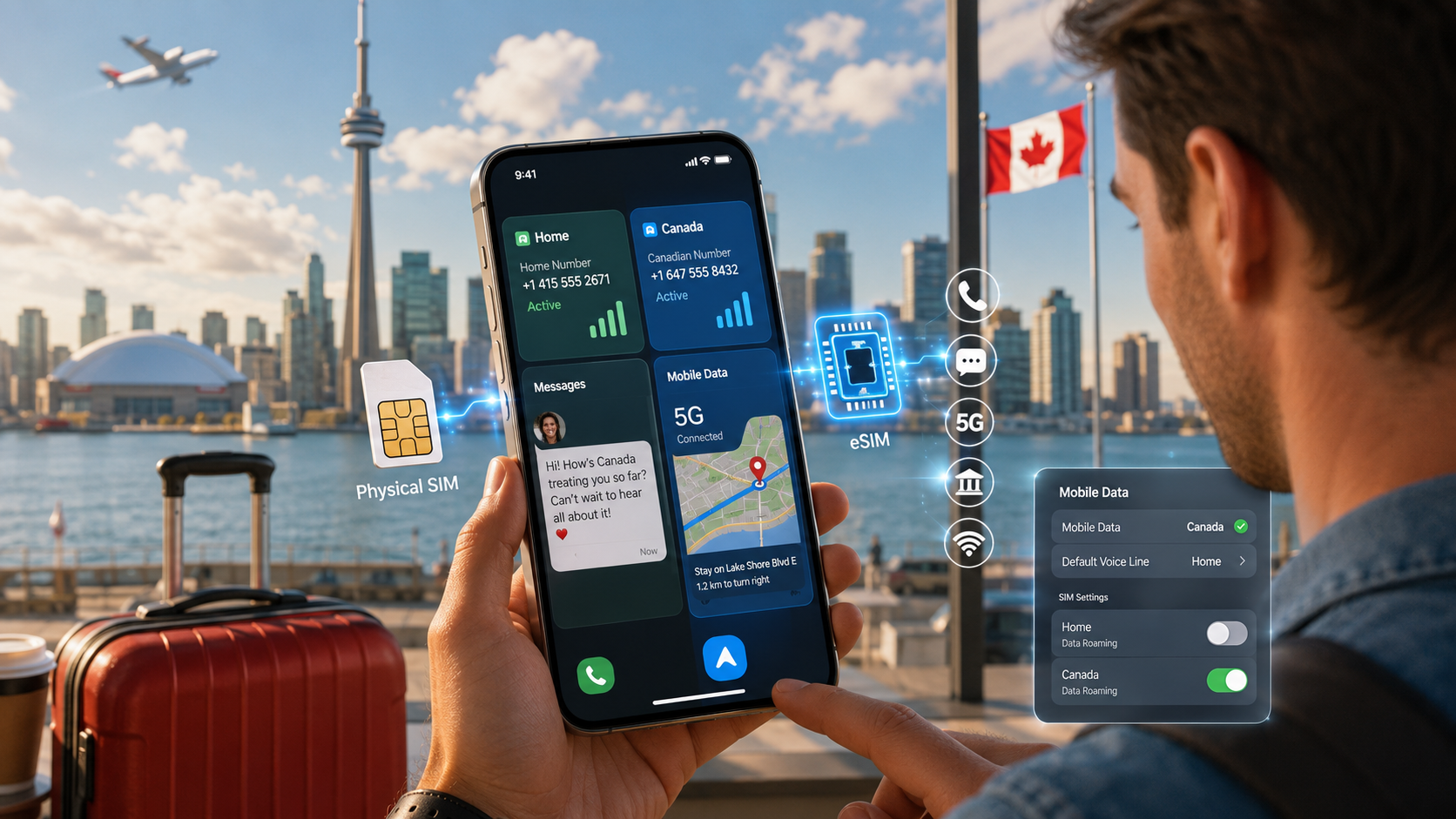
Dual SIM lets you run two numbers on one phone, so you can keep your home number for family and add a Canadian number for local calls and data. On most modern iPhones and Android phones, you use one physical SIM plus one eSIM, or two eSIMs. Dual SIM means your phone can hold two active lines at once. It's a simple way to stay reachable on both.
This guide shows how to set up dual SIM travel in Canada, how to control which line does what, and how to avoid surprise roaming charges.
Key takeaways
- Dual SIM runs two numbers on one phone at the same time.
- Keep your home number active for texts from family and banking codes; use a Canadian line for data and local calls.
- Most newer phones support one physical SIM + one eSIM, and many support two eSIMs.
- Set your Canadian line as the default for data to avoid home-country roaming fees.
- Turn off data roaming on your home line so it doesn't quietly use data.
What is dual SIM and why use it in Canada?
Dual SIM is a phone feature that lets you use two SIM lines on one device at once. In Canada, it's popular with newcomers and travellers because you can keep your home number and add a local Canadian number without carrying two phones.
That combo covers the two things people need most: staying reachable on your usual number and having affordable local data and calls. To pick a Canadian line, you can compare plans and choose an eSIM or physical SIM that fits your stay.
Does your phone support dual SIM?
Most phones from the last few years support dual SIM, usually as one physical SIM plus one eSIM. Some support two eSIMs. Older or budget phones may only take one SIM.
To check:
- On iPhone, look for eSIM support in Settings > Cellular. If you can add a plan there, you can run dual SIM.
- On Android, check Settings > SIM manager or your phone's spec sheet for "Dual SIM" or "eSIM."
- Confirm your phone is unlocked, since a locked phone can block a second carrier's SIM.
If you're not sure your device works on Canadian networks, read our guide on whether your phone will work in Canada first.
How do you set up dual SIM in Canada?
Set up your Canadian line as an eSIM and keep your home SIM in place. The general steps are:
- Keep your home SIM (physical or eSIM) active on the phone.
- Add your Canadian eSIM by scanning the QR code from your provider. Our eSIM activation guide walks through this.
- Label each line clearly, for example "Home" and "Canada."
- Set the Canadian line as your default for cellular data.
- Choose which line to use for calls and texts, or set it to ask each time.
- Turn off data roaming on your home line.
Once set, your phone shows two signal bars, one for each line. You can receive calls and texts on both numbers at the same time.
How do you control which line is used for calls, texts, and data?
You choose a default line for each task in your phone's settings, and you can override it per call. This is the key to keeping costs down and staying reachable.
- Set data to your Canadian line, so browsing and maps use local data.
- Set calls and texts based on your needs. Keep your home line for family and verification codes; use the Canadian line for local calls.
- On iPhone, manage this under Settings > Cellular > Cellular Data and each line's settings. On Android, use SIM manager to pick defaults.
For any single call, you can pick the line before dialling, which is handy for international calls. To weigh calling options, see the best ways to call home from Canada.
Home SIM vs Canadian SIM: what should each one do?
Here's a simple way to split the two lines while you're in Canada.
| Task | Home line | Canadian line |
|---|---|---|
| Receiving family calls/texts | Yes | Optional |
| Bank and app verification codes | Often yes | Optional |
| Mobile data and maps | Off (avoid roaming) | Yes |
| Local calls in Canada | No | Yes |
| Data roaming | Turn off | On if provider requires |
Keeping data on the Canadian line and roaming off on the home line is what prevents surprise bills. Roaming means using another network abroad, which your home carrier can charge a lot for.
How do you avoid roaming charges with dual SIM?
Turn off data roaming on your home line and use your Canadian line for all data. Your home number can still receive texts and calls without using data, but leaving its data roaming on can rack up charges quietly in the background.
A safe setup:
- Home line: data roaming off, kept for calls and texts you care about.
- Canadian line: set as default data, used for internet.
- Double-check both settings after you land.
For a wider view of the roaming-versus-local-SIM choice, see our guide on using a US phone plan in Canada. To plan your setup, see how it works.
FAQ
Can I use two eSIMs at the same time?
Many newer phones can store several eSIMs and use two lines at once, so yes on supported devices. Some phones hold multiple eSIM profiles but only keep two active together. Check your phone's specs for how many eSIMs it supports simultaneously before you rely on a two-eSIM setup.
Will keeping my home SIM in cost me money?
Not just by being in the phone. Receiving texts is usually free, but making calls or using data while roaming can cost a lot. The safe move is to keep the home line for incoming texts and calls, turn its data roaming off, and use your Canadian line for internet.
Can I still get bank codes on my home number?
Yes. If your home line is active, it can receive SMS verification codes as normal, as long as your home carrier delivers texts while you're abroad. This is a common reason people keep the home line on a dual SIM setup. Test it early so you're not locked out later.
Do I need a physical SIM for dual SIM, or is eSIM enough?
Either can work. A common setup is your home physical SIM plus a Canadian eSIM. If your phone supports two eSIMs, you can go SIM-free entirely. An eSIM is a digital SIM built into the phone, so there's no card to insert. Choose based on your phone and provider.
Which line should be my default for data in Canada?
Your Canadian line. Setting it as the default for cellular data means browsing, maps, and apps use local data instead of expensive home-country roaming. You can still receive calls and texts on your home line at the same time. Just remember to switch data back when you return home.
Ready to run two numbers at once? Compare plans for a Canadian eSIM, then follow our eSIM activation guide to finish setup.
For device help, see Apple's page on using dual SIM.
Follow Get Canada Sim on Google
Make Get Canada Sim a preferred source to find our latest Canada SIM and eSIM guides in Google Search.