

How to Choose a Phone Plan in Canada Without Overpaying
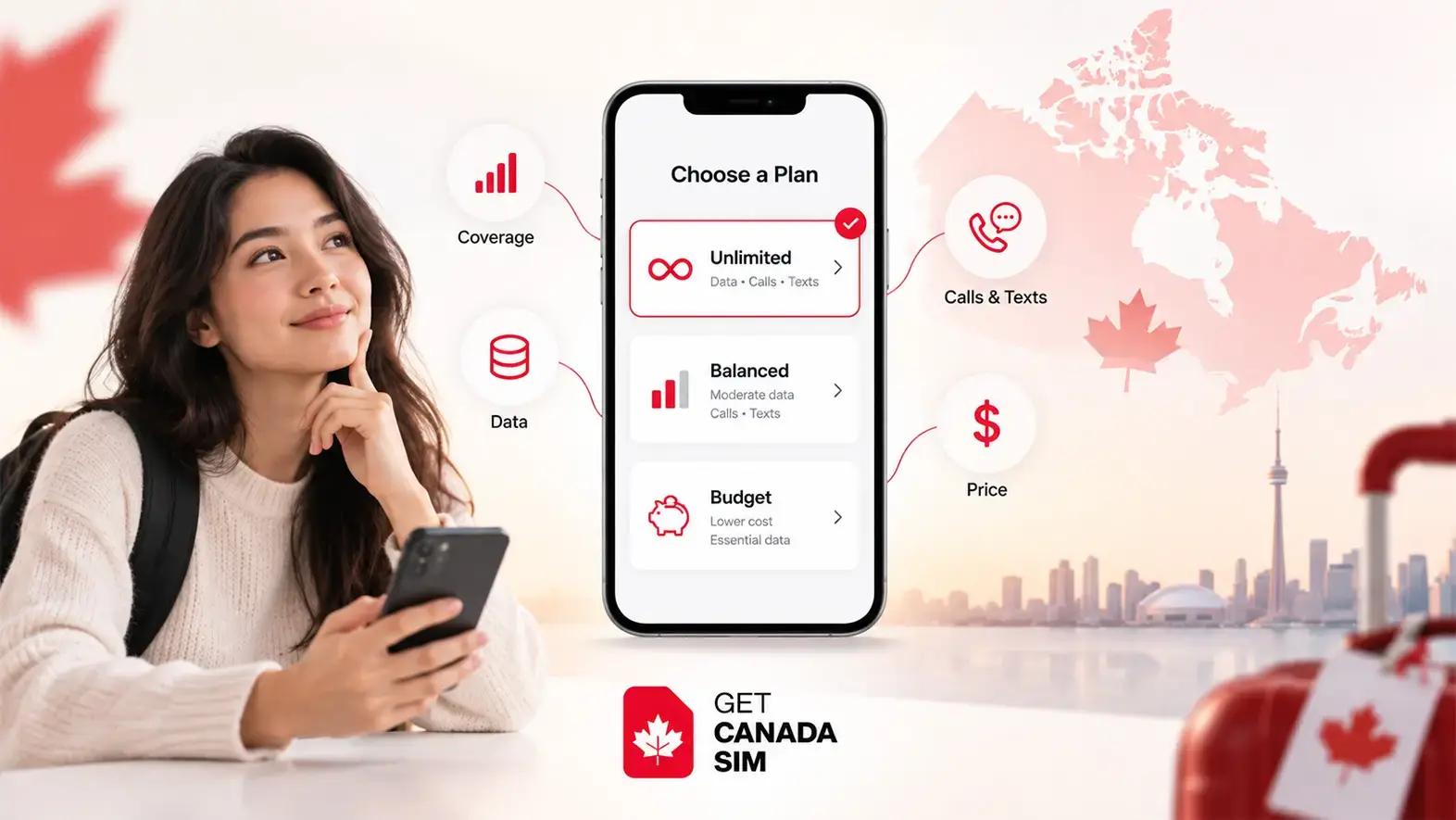
If you are trying to figure out how to choose a phone plan in Canada, do not start by asking which carrier gives you the most data.
Start with yourself.
Are you a student who spends most of the day on campus Wi-Fi? A newcomer who may not have home internet during the first few weeks? A worker who needs to connect a laptop? A tourist staying for only ten days? Or someone who mainly calls, texts, and hardly uses mobile data?
Those people should not be buying the same plan.
Your guide to choosing a phone plan in Canada is therefore simple: buy enough service for the life you actually live, not the largest package you can afford.
Here is a useful starting point:
| If you are… | What matters most | Start by looking for |
|---|---|---|
| Student | Budget + Wi-Fi availability | Moderate data, affordable monthly price |
| Newcomer | First-month flexibility | Reliable data, Canadian number, optional hotspot |
| Employee/work permit holder | Work communication | Coverage, hotspot, dependable monthly data |
| Tourist | Length of trip | Prepaid or short-term eSIM |
| Senior | Calls, texts, simplicity | Low-data or talk-and-text plan |
| Heavy data user | Streaming / hotspot | High-data or unlimited plan |
| Mostly on Wi-Fi | Keeping cost down | Small-data BYOD or prepaid plan |
That already gets you closer to the right answer than simply searching for the biggest number of gigabytes.
1. How to Choose a Cell Phone Plan in Canada If You Are a Student
Imagine you have just started university.
You live in residence. Your room has Wi-Fi. The library has Wi-Fi. Your classrooms have Wi-Fi. Even the coffee shop where you study probably has Wi-Fi.
In that situation, would I pay extra every month for 150 GB of mobile data?
Probably not.
Your mobile data is mainly filling the gaps: Google Maps on the bus, Spotify on your commute, WhatsApp, Instagram, occasional video, banking apps and browsing when Wi-Fi is unavailable.
That is why choosing a cell phone plan in Canada as a student is more about identifying those gaps than buying the biggest package.
Get Canada SIM's student guide notes that many students can manage comfortably with roughly 10–50 GB when they have reliable Wi-Fi at home and on campus.
But change the situation slightly.
Suppose you commute for 90 minutes each way, watch videos on the train and sometimes tether your laptop. Suddenly, 10 GB may feel restrictive. A larger data plan starts making sense.
So my decision would be:
Campus Wi-Fi + home Wi-Fi → prioritize price. Long commute + streaming → prioritize data. Laptop tethering → check hotspot before anything else.
And if you are studying in Canada for several years, I would normally compare ongoing monthly service rather than repeatedly purchasing short-term tourist packages.
You can go deeper with the Get Canada SIM international student phone-plan guide or see the student SIM options.
2. Choosing the Best Mobile Plan in Canada If You Are a Newcomer
Now imagine you are moving to Canada permanently.
Your first month looks very different from a student's normal semester.
You may be using Maps constantly. You may be viewing apartments, travelling between appointments, contacting family, receiving calls, using transit apps and trying to set up home internet.
That changes the decision.
When choosing the best mobile plan in Canada as a newcomer, I would give myself a little more data than I expect to need during a normal month.
Why?
Because your first month probably is not a normal month.
If your apartment already has reliable Wi-Fi, a moderate-data plan may be perfectly adequate. But if you are moving into temporary accommodation and do not know when home internet will be installed, I would pay much closer attention to hotspot support.
Hotspot means using your phone's mobile data to connect a laptop or another device.
Get Canada SIM currently makes this same distinction on its newcomer page: its higher-data Rogers option includes hotspot, while its lower-priced Fido option is positioned for people who already have dependable home internet.
That is useful decision-making because it asks what will happen in your first month, rather than simply asking which plan has more data.
If you are still overseas, you can also compare the current Canada SIM and eSIM plans before departure and see how pre-arrival activation works.
For people moving long-term, the dedicated newcomer SIM guide goes further into that situation.
3. Pick the Best Cell Phone Service Plan for You If You Work in Canada
Now imagine you work five days a week.
You leave home at 7:30 a.m., use Maps or transit on the commute, receive calls during the day, use messaging with colleagues, and occasionally open documents or join a meeting away from Wi-Fi.
Your phone is no longer just entertainment.
It is part of your working day.
So when trying to pick the best cell phone service plan for you, I would ask one question before worrying about 50 GB versus 100 GB:
Will I ever need to connect my laptop through my phone?
If the answer is yes, hotspot support may matter more than an extra 20 GB of advertised data.
That becomes even more important for contractors, field workers, salespeople, drivers, people travelling between sites and anyone whose home internet is not completely reliable.
Get Canada SIM's current work-permit guide makes hotspot the main distinction between its available options for exactly this reason.
You can see the dedicated phone-plan guidance for work-permit holders.
If, on the other hand, you sit in an office with excellent Wi-Fi all day and have Wi-Fi at home, I would probably save the money and choose a smaller data plan Canada option rather than paying for capacity I rarely touch.
4. If You Are a Tourist, Stop Comparing Plans as Though You Live Here
A tourist staying for eight days has a completely different problem. You can check SIM plan for tourists.
You probably need Google Maps, Uber or Lyft, restaurant searches, messaging, photos, maybe calls—and then you leave.
Why would you automatically choose an ongoing monthly postpaid plan?
For a short visit, I would first compare a prepaid SIM or eSIM with my existing carrier's Canadian roaming.
For example, imagine:
Trip A: four days in Toronto with roaming already included in your home plan. Buying another SIM may not be worth the trouble.
Trip B: three weeks driving through Canada while using navigation every day. A local prepaid option may make much more sense.
Trip C: six weeks visiting family and you expect Canadian businesses or relatives to call you. A plan with a Canadian phone number may be more useful than a data-only travel eSIM.
Get Canada SIM currently offers dedicated tourist SIM and prepaid eSIM options, and its tourist page specifically organizes the decision around trip length rather than treating visitors like long-term residents.
Not sure whether you should use digital or plastic SIM? Read the eSIM vs physical SIM comparison.
5. How to Choose a Phone Plan in Canada for Seniors
Now consider someone who is 70, uses their phone mostly to call family, sends messages, checks the weather and occasionally uses Maps.
Would I recommend an expensive unlimited data package simply because it is marketed specifically to seniors?
No.
When researching how to choose a phone plan in Canada for seniors, I would first find out how much data the person actually uses.
For light users, simplicity may matter more than speed or a huge allowance.
The cheapest phone plans Canada for seniors may therefore turn out to be ordinary prepaid or low-data plans rather than products carrying a “senior” label.
For comparison, Lucky Mobile's current prepaid lineup starts at $19/month for 500 MB, with higher-data options above that. That does not automatically make Lucky the right provider; coverage, support and actual usage still matter.
What is the new $25 plan at Rogers for seniors?
Be careful with this search.
Rogers currently has a dedicated Adults 65+ category for specialized offers, but the public page we could verify does not show a general nationwide $25 senior plan. (Rogers) Rogers' separately listed talk-and-text plan is currently $30/month for new activations.
So if you see a video or post about a "$25 Rogers senior plan," check the date, province, eligibility and whether it was a temporary promotion.
That also answers another common question: What is the cheapest phone plan for seniors?
There is no permanent answer. For a light user, start with low-data prepaid and talk-and-text plans before looking at large-data senior packages.
6. If You Work Remotely or Use a Lot of Data, “Unlimited” Needs a Closer Look
Suppose you watch video every day, use your phone as a hotspot, work remotely or spend very little time on Wi-Fi.
Now the calculation changes again.
You may genuinely benefit from unlimited data plans.
But Canadian unlimited cellular data plans do not all mean the same thing.
Some plans provide a set amount of full-speed data and then continue at a reduced speed. Get Canada SIM's current Rogers plans, for example, show 100 GB or 120 GB of high-speed usage before reduced-speed unlimited data continues.
So when looking for the best unlimited data plan or the cheapest unlimited data plans Canada has available, compare:
- How much full-speed data you receive.
- What happens after that allowance.
- Whether hotspot is included.
- Whether Canada/U.S. roaming is included.
- The normal price after discounts.
The same applies when people search for the cheapest phone plans with unlimited everything. Unlimited calling, unlimited texts and unlimited data can each have different conditions.
If I used only 12 GB every month, I would not pay extra for an unlimited plan.
If I regularly used 90 GB and tethered a laptop, I would.
7. How Do I Pick a Phone Plan? Use This Five-Minute Test
When people ask “How do I pick a phone plan?”, this is the process I would actually use.
First, open your current phone bill or carrier app and look at your last three months of data. Do not estimate.
Second, check where you need coverage. Someone living and working in downtown Toronto has different needs from someone regularly travelling through rural Alberta or Northern Ontario.
Third, decide whether you are bringing your own phone. If you already have a good unlocked device, a BYOD—bring your own device—plan keeps the phone cost separate from your service cost. Before travelling, you can use Get Canada SIM's phone compatibility and IMEI guide.
Fourth, decide between prepaid and postpaid. The prepaid vs postpaid Canada guide explains the difference in detail.
Finally, calculate what you will actually pay—not simply how impressive the data allowance looks.
That is how to choose a cell phone plan in Canada without getting distracted by marketing.
Cheap Phone Plans in Canada: Cheap Compared With What?
Search Google for cheapest phone plans Canada, cheapest cell plan Canada, cheapest mobile phone plans Canada, cheapest mobile plans Canada, cheap mobile phone plans Canada, or most affordable cell phone plans in Canada, and you will see plenty of attractive numbers.
But there is a problem.
A $20 plan with almost no data and a $35 plan with enough data for your entire month are not competing for the same customer.
A useful example comes from Reddit. In one 2026 discussion, a Fido customer paying $54 for 60 GB wanted something cheaper. The most useful question another user asked was essentially: how much of that data do you actually use? (Reddit)
Another student discussion started with someone paying for 100 GB while saying they only needed around 40 GB.
That is the trap.
People often optimize price per gigabyte instead of their monthly bill.
If Plan A gives you 100 GB for $50 and Plan B gives you 25 GB for $30, Plan A may look like better value per gigabyte.
But if you use 8 GB, Plan B leaves $20 in your bank account every month.
That is real value.
What About a $5, $10 or $15 Phone Plan in Canada?
Search demand for a $5 phone plan Canada, $10 phone plan Canada or $15 phone plan Canada usually comes from people who hardly use mobile data.
Maybe it is a backup phone. Maybe it is for a senior. Maybe the user spends almost all day on Wi-Fi.
Those ultra-low prices do occasionally appear as legacy, annual, regional or temporary offers, but you should not assume an old Reddit post is still available.
A 2025 Reddit discussion, for example, referenced an old Freedom $5 option and immediately noted that it was no longer offered.
So instead of deciding, “I must find a $10 plan,” decide:
I need calls, texts and almost no data. What is the lowest current price that meets that need?
That produces better results.
What Is the Cheapest but Good Phone Plan?
The phrase “What is the cheapest but good phone plan?” is actually a much better question than simply asking for the cheapest.
“Good” means it works where you live and provides enough data for your normal month.
For some people, Lucky Mobile plans Canada offers may deserve comparison because Lucky currently lists prepaid options starting at $19/month.
For someone else, another provider may have better coverage or a promotion that makes more sense.
There is no provider that is automatically the cheapest for every Canadian.
Are Costco Phone Plans Cheaper?
They can be, particularly when Costco is running a member promotion, but do not compare the Shop Card or device discount alone.
Costco Mobility currently advertises a 50 GB BYOD offer at $34/month, subject to conditions, alongside various device and Shop Card promotions.
So when asking “Are Costco phone plans cheaper?”, calculate:
monthly plan × number of months + device cost − genuine benefits you would actually use.
A $150 Shop Card does not automatically compensate for paying an extra $15 every month for two years.
Can You Get a Phone Plan for Just the Phone?
Yes.
If by “Can you get a phone plan for just the phone?” you mean mobile service without buying another smartphone, search for BYOD or BYOP plans.
You keep your existing compatible device and buy only the service.
For many people looking at cell phone plans Canada, this is the cleanest comparison because phone financing is removed from the equation.
What Is the Best Cell Phone Plan for One Person?
For a single line, family-plan discounts are irrelevant.
So what is the best cell phone plan for one person?
Usually, it is the lowest-cost plan that gives that person:
enough data + acceptable coverage + the features they actually use.
A single person using 15 GB every month does not become better connected because the carrier gives them 150 GB.
They simply own 135 GB they probably will not use.
How Can I Lower My Cell Phone Bill?
Start with unused data.
Then look at expired promotional discounts, unnecessary add-ons, phone financing, international features you no longer use and whether your existing phone could move to a cheaper BYOD plan.
Canadian Reddit discussions repeatedly show people switching plans because they realized their allowance was much larger than their actual usage. (Reddit)
So before negotiating with your carrier, know two numbers:
What you pay and how much data you actually use.
Those numbers give you something meaningful to negotiate around.
Who Has the Best Phone Plan in Canada Right Now?
There is no universal answer.
The person who needs 500 MB, the university student who needs 20 GB, the worker who needs hotspot, and the remote worker who needs unlimited data should not receive the same recommendation.
That is also why searches such as Canada Cell Phone Plans, cell phone plans Canada, cell plans in Canada, mobile phone plans in Canada, mobile plans Canada, Canada phone plans, data plans Canada, and data plan Canada produce so many different answers.
The market is not offering one product.
It is solving many different problems.
So instead of asking:
“Who has the best phone plan in Canada right now?”
Ask:
“Which current plan gives me the coverage, data and features I need for the lowest total monthly cost?”
That question is far more likely to lead you to the right choice.
Before You Choose, Picture Your Normal Tuesday
That is probably the easiest way to make the decision.
If you are a student, picture your commute and campus Wi-Fi.
If you are a newcomer, picture your first few weeks before everything is set up.
If you work, picture whether your laptop may ever need your phone's internet.
If you are a tourist, picture how many days you will actually be here.
If you are a senior, picture what you genuinely do with the phone each week.
If you are a heavy user, look at your real data consumption instead of simply assuming you need one of the biggest unlimited plans.
That is the difference between buying a package and choosing a plan.
You are not trying to find the biggest number.
You are trying to find the plan that disappears into your life because it simply does what you need it to do.
If you are preparing to come to Canada, you can start by comparing Get Canada SIM's current plans side by side. And if you are still planning from overseas, Get Canada SIM also has country-specific guidance—for example, its Canada SIM from India guide—so you can compare your options before the flight rather than making the decision after arrival.
Frequently Asked Questions
How do I pick a phone plan?
Check coverage where you live and travel, review your actual monthly data use, choose between prepaid and postpaid, decide whether you will bring your own phone, and compare the total monthly cost. Pick the smallest plan that comfortably covers your needs.
What is the cheapest but good phone plan?
There is no permanently cheapest good plan because Canadian prices and promotions change. Look for the lowest-cost plan that still gives you reliable coverage, enough data, and the features you need. A cheaper plan is not better if its data, speed, hotspot access, or coverage does not fit your usage.
How to choose a phone plan in Canada for seniors?
Start with actual usage: calls, texts, mobile data, coverage, and ease of support. Seniors who mainly use Wi-Fi may be better suited to a low-data prepaid or BYOD plan than a large senior-specific package. A plan labelled for seniors is not automatically the cheapest option.
What is the best cell phone plan for one person?
Usually, it is the lowest-cost plan that provides reliable coverage, enough data, and the features that person actually uses. If you normally use 8 GB a month, for example, paying more for 100 GB may offer little practical value.
Are unlimited plans really unlimited?
Not always at full speed. Some unlimited plans include a set amount of high-speed data and then reduce your speed after you reach that limit. Check the full-speed allowance, reduced-speed terms, and hotspot rules before choosing an unlimited data plan.
Final Answer: Pick the Plan That Matches Your Life
The easiest way to understand how to choose a phone plan in Canada is to stop thinking about plans for a moment and think about your normal day.
Where are you most of the time? Do you have Wi-Fi there? How much data do you really use? Do you need hotspot? Are you staying in Canada for two weeks or several years?
A student may need an affordable moderate-data plan. A newcomer may want more flexibility during the first month. A worker may care more about hotspot and coverage. A tourist may only need a short-term prepaid option. A senior who mostly calls and texts may have little reason to pay for a large data allowance.
The goal is not to find the plan with the most gigabytes.
It is to find the plan that gives you enough coverage, enough data, and the features you actually use—at a price that makes sense for you.
That matches the strongest idea already running through the article: picture your normal life first, then choose the plan around it.
If you are preparing to come to Canada, you can compare Get Canada SIM plans and check the inclusions before deciding.
Follow Get Canada Sim on Google
Make Get Canada Sim a preferred source to find our latest Canada SIM and eSIM guides in Google Search.