

Does Paying a Phone Bill Build Credit in Canada?
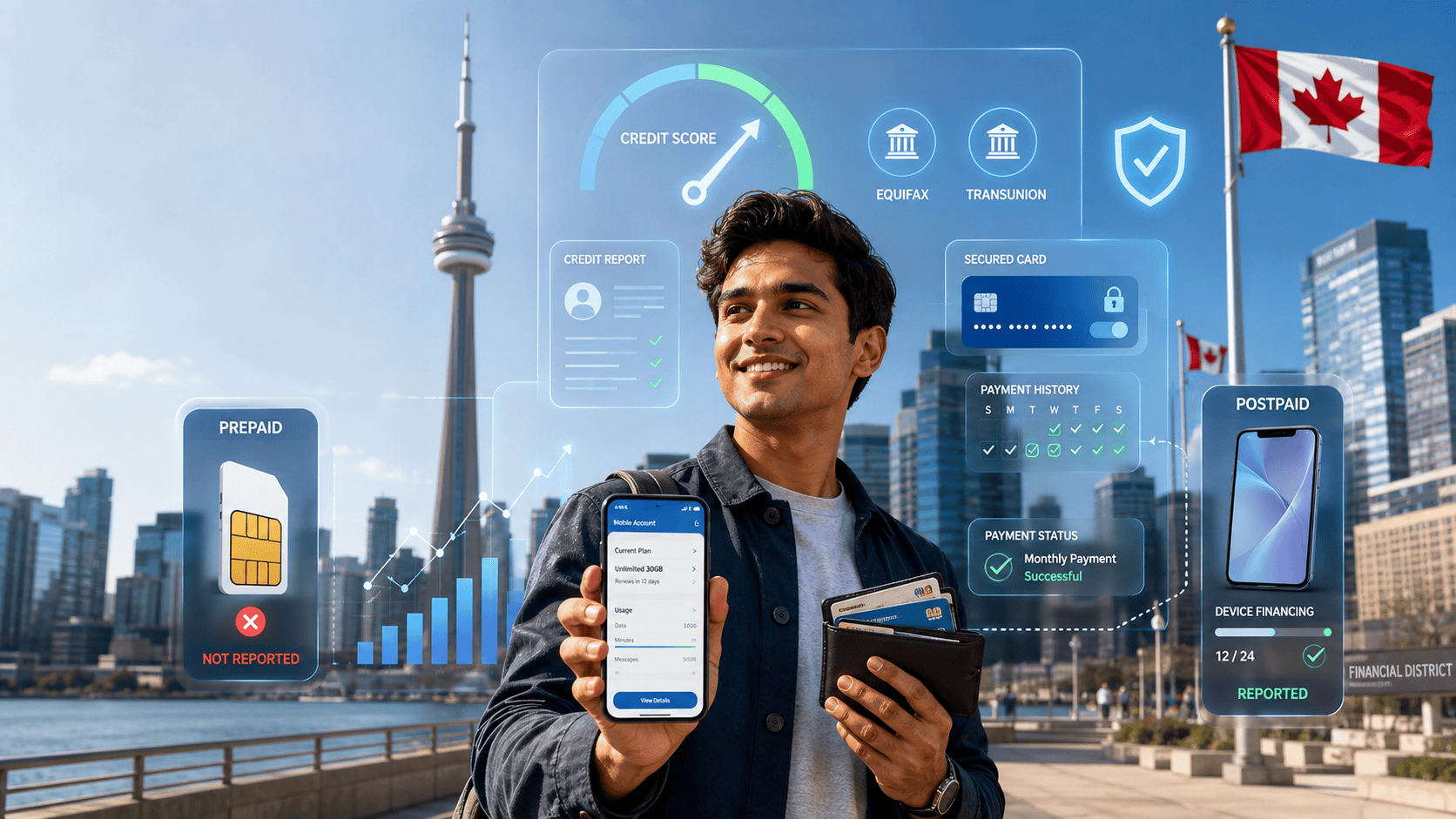
Most prepaid phone plans in Canada do not build your credit, because prepaid providers usually don't report your payments to Canada's credit bureaus. Some postpaid plans that include a financed device or a credit check can appear on your credit report. If building credit fast is your goal, a phone bill alone is rarely enough — you'll want a secured credit card or credit-builder product alongside it.
If you're a newcomer looking for a phone plan without Canadian credit history, prepaid is often one of the simplest options. You can also compare Canada phone plans without a credit check before choosing a plan.
Key takeaways
- Prepaid phone plans (pay-before-you-use, no contract) generally do not report to Equifax or TransUnion, Canada's two credit bureaus.
- Postpaid plans (billed monthly, sometimes with a financed phone) may involve a credit check and may be reported, depending on the carrier — always confirm directly with the provider.
- A phone bill, even if reported, is usually a small factor compared to credit cards and loans.
- Newcomers building credit from zero are usually better served by a secured credit card or a credit-builder loan.
- Get Canada SIM plans are prepaid connectivity products, not credit products.
How does credit actually work in Canada?
Canada has two major credit bureaus, Equifax and TransUnion. A credit bureau is a company that collects your borrowing and repayment history from lenders and turns it into a credit report and credit score. Banks, landlords, and some employers can check this report when you apply for credit, a lease, or certain jobs.
Your score is built mostly from things like: whether you pay bills on time, how much of your available credit you're using, how long you've had credit accounts open, and how many new accounts you've opened recently. The Financial Consumer Agency of Canada has a plain-language breakdown of how credit reports and scores work if you want the full picture.
The important detail: only accounts that get reported to a bureau affect your score. Plenty of everyday bills — rent, most prepaid phone plans, streaming subscriptions — are never reported at all, so paying them on time, while good practice, does nothing for your credit file.
If you're starting from zero after moving to Canada, our guide on how to build credit in Canada as a newcomer explains the more direct ways to establish a Canadian credit history.
Does a prepaid SIM or eSIM build credit?
No, in almost all cases. Prepaid means you pay for service in advance and there's no bill, no contract, and no credit check. Because there's no ongoing debt or repayment relationship, there's nothing for the carrier to report to Equifax or TransUnion. This applies whether you're using a physical SIM or an eSIM (an eSIM is a digital SIM built into your phone that you activate with a QR code instead of a plastic card).
The important distinction is that SIM type doesn't determine whether you're building credit. Prepaid versus postpaid matters more than whether you use an eSIM or a physical SIM.
If you're deciding between the two, our eSIM vs physical SIM guide for newcomers explains the practical differences.
This is true across the industry, not just for one provider. If a company markets a prepaid SIM as a credit-building tool, that claim needs scrutiny — ask them directly which bureau they report to and get it in writing.
Can a postpaid phone plan build credit?
Sometimes — it depends on the carrier and the specific plan. Postpaid means you use the service first and get billed monthly, often with a contract. Some postpaid plans, especially ones that include device financing (paying off a phone over 24 months, for example), involve a credit check when you sign up. Whether the ongoing account gets reported to a credit bureau varies by carrier and isn't guaranteed even then.
If credit building matters to you, don't assume. Ask the carrier two direct questions:
- "Do you run a credit check for this plan?"
- "Do you report payment history to Equifax or TransUnion?"
Get the answer before you commit, not after.
For a broader comparison of prepaid and postpaid options, see our guide to prepaid phone plans in Canada, which compares plan types, networks, and situations where prepaid makes sense.
If credit building matters to you, don't assume — call the carrier and ask two direct questions: "Do you run a credit check for this plan?" and "Do you report payment history to Equifax or TransUnion?" Get the answer before you commit, not after.
What actually builds credit for newcomers in Canada?
The tools most newcomers use to build a Canadian credit history from scratch are secured credit cards, credit-builder loans, and sometimes a regular unsecured credit card if a bank will approve one without local history.
| Option | Reports to bureaus? | Credit check needed? | Typical for newcomers? |
|---|---|---|---|
| Prepaid phone plan | Rarely/no | No | N/A — not a credit product |
| Postpaid phone plan | Sometimes | Often yes | |
| Secured credit card | Yes | Minimal — backed by a deposit | Very common |
| Credit-builder loan | Yes | Minimal | Common at credit unions/newcomer programs |
| Standard credit card | Yes | Yes, full check | Harder without history |
A secured credit card works by putting down a deposit (say $500) that becomes your credit limit. You use the card normally, the issuer reports your payments monthly, and the deposit protects them if you default. After several months of on-time payments, many newcomers qualify to upgrade to an unsecured card. Several Canadian banks and credit unions market these specifically to newcomers — compare a few before choosing one, since terms and fees differ.
Should newcomers rely on a phone bill to build credit?
No — treat your phone plan as a connectivity decision, not a credit strategy. Even in the best case, where a postpaid plan is reported, it's one account among several factors, and it won't move your score as fast as a credit card with a track record of payments. Pick your phone plan based on what you actually need — data, calling, activation timing — and pick a dedicated credit product for building your file.
That said, paying every bill on time, including ones that aren't reported, is still a good habit. It keeps your finances predictable while you're getting other accounts established, and some landlords or employers do informal reference checks that aren't part of the formal credit system.
What about credit builder programs aimed specifically at newcomers?
Several Canadian banks, credit unions, and settlement organizations run programs designed specifically for newcomers with no local credit history, and these are usually a more direct path than a phone bill.
These programs often combine a secured credit card or small credit-builder loan with financial literacy support, and some partner directly with immigrant settlement agencies.
If you're not sure where to start, a settlement agency in your city can often point you toward vetted, newcomer-specific options rather than you having to compare bank products cold.
If you're also still sorting out your mobile service, our guide to Canada phone plans without a credit check explains the main options for getting connected without an established Canadian credit history.
How long should you wait before applying for credit-building products?
You can typically start as soon as you have a Canadian address and government-issued ID, sometimes within your first weeks in the country — there's usually no need to "wait and settle in" first. Many newcomers make the mistake of assuming they need months of Canadian history before a bank will consider them, but secured credit cards specifically exist to solve that problem by removing the lender's risk through a deposit. Applying early, as long as you can manage the payments, generally means you start building a usable credit file sooner rather than later.
FAQ
Does Get Canada SIM report payments to Equifax or TransUnion? Get Canada SIM offers prepaid connectivity, and prepaid plans typically aren't reported to credit bureaus..
How long does it take to build credit in Canada as a newcomer? It varies, but many newcomers see a usable credit score within 6 to 12 months of consistent, on-time payments on a reported product like a secured credit card, according to general guidance from Canadian financial institutions and settlement agencies.
Can I use my home country's credit history in Canada? Generally no. Canadian credit bureaus don't import foreign credit history, so most newcomers start with no Canadian score regardless of their credit history abroad.
Will missing a phone bill hurt my credit if the plan isn't reported? If the plan truly isn't reported, a missed payment won't show up on your credit report — but the carrier can still suspend service, charge late fees, or send the account to collections, and collections agencies often do report to credit bureaus.
Is a secured credit card better than a phone plan for building credit? Yes, for credit-building purposes specifically. A secured card is designed to report to bureaus and build history; a phone plan, especially prepaid, generally isn't.
Should I get a Canadian number before I look into credit building? The two are separate tasks, but doing them close together makes sense — see our guide on buying a Canadian SIM before you land for the connectivity side, and talk to a bank or newcomer settlement service for the credit side.
Ready to sort out your connectivity first? Compare plans or check how activation works.
Follow Get Canada Sim on Google
Make Get Canada Sim a preferred source to find our latest Canada SIM and eSIM guides in Google Search.