

Prepaid vs Postpaid in Canada: Which Is Right for Newcomers?
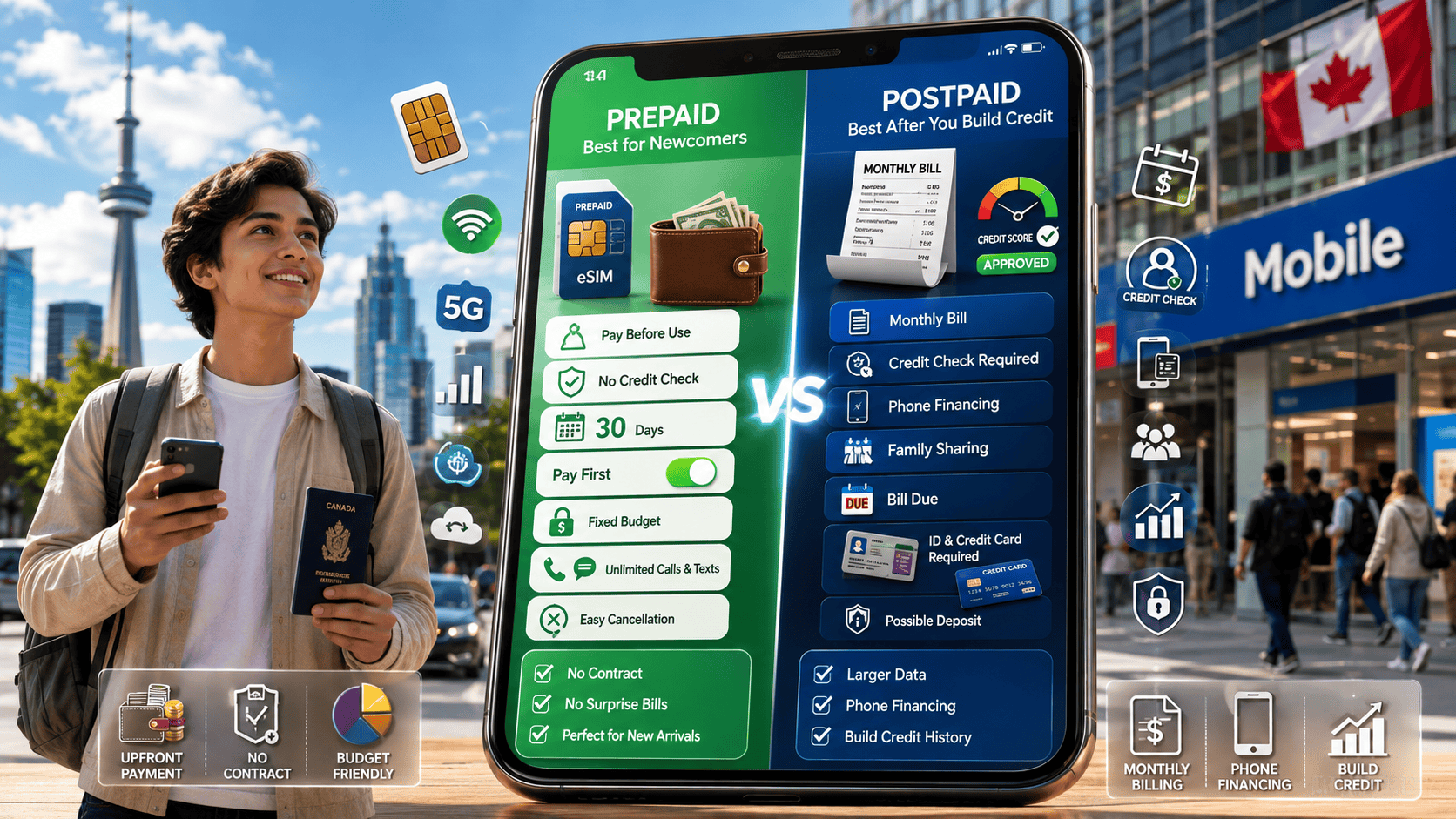
Prepaid vs postpaid in Canada comes down to one thing: do you pay before you use the service, or after? Prepaid means you load money first and use what you paid for. Postpaid means you use the service all month and get a bill later. For most newcomers, prepaid is the easier place to start, because postpaid usually needs a credit check.
Key takeaways
- Prepaid = pay first, no bill, no credit check, easy to cancel.
- Postpaid = monthly bill after use, often needs a credit check, ID, and sometimes a deposit.
- New arrivals often can't pass a Canadian credit check yet, since they have no credit file here.
- Prepaid works well for your first weeks or months; you can move to postpaid later once you're settled.
- Only postpaid accounts are typically reported to credit bureaus — prepaid usually isn't.
What does prepaid mean in Canada?
Prepaid means you pay for your mobile service before you use it. You top up an amount, that buys you a set block of data, calls, and texts for a set period (usually 30 days), and when it runs out you either top up again or the service pauses.
There's no contract and no monthly invoice. If you stop topping up, the plan simply ends. Some carriers keep your number active for a short grace period after your balance expires, but that window varies by provider — check the terms before you rely on it.
Prepaid is common worldwide, so if you're coming from Bangladesh, India, Nigeria, the Philippines, or most of Europe, it'll feel familiar.
What does postpaid mean in Canada?
Postpaid means you use the service for a month, then get a bill for it afterward. This is the "normal" plan type Canadians talk about, and it's what carriers push hardest.
Postpaid usually includes things prepaid often doesn't: larger data buckets, phone financing (paying off a handset over 24 months), family plans with shared data, and easier add-ons. It also usually comes with a credit check, a request for government ID, and sometimes a security deposit if you don't have Canadian credit history.
Prepaid vs postpaid: a side-by-side comparison
| Feature | Prepaid | Postpaid |
|---|---|---|
| When you pay | Before you use it | After the month ends |
| Credit check | Usually not required | Usually required |
| Deposit possible | Rare | Yes, if no credit history |
| Contract | No | Often a term or device agreement |
| Overage charges | No — service stops or slows | Yes, possible |
| Cancel anytime | Yes | May involve fees or device balance |
| Phone financing | Rarely offered | Commonly offered |
| Reported to credit bureaus | Usually no | Sometimes yes |
| Good for a short stay | Yes | Less so |
Both are legitimate options. Neither is universally better — it depends on how long you're staying, what documents you have, and how predictable you want your costs to be.
Why can't newcomers just get a postpaid plan right away?
Because a Canadian credit check needs a Canadian credit file, and you don't have one the day you land. Credit history doesn't travel across borders. Your excellent record back home doesn't appear when a Canadian carrier runs a check.
Carriers respond to a "no file found" result in different ways. Some decline the application. Some approve it with a deposit. Some offer a smaller plan with a lower limit. What happens to you depends on the carrier's own policy, so it's worth asking directly rather than assuming.
This is one reason many newcomers start prepaid and switch later. It's also why arriving with a working number already sorted takes pressure off — you can shop for a postpaid plan calmly instead of standing at an airport kiosk with no internet. If that's your situation, buying before arrival is worth reading first.
Does prepaid or postpaid help you build credit in Canada?
Prepaid generally does not build credit, because there's no borrowing involved — you've already paid. Some postpaid accounts are reported to Canadian credit bureaus, which means paying on time can contribute to your file, and paying late can hurt it.
But "some" is doing real work in that sentence. Reporting practices differ by carrier and by account type, and carriers can change them. Never assume a phone plan builds credit unless the provider states it in their own terms. We cover the details in does paying a phone bill build credit in Canada and how to build credit in Canada as a newcomer.
Which should you choose for your first months in Canada?
Start with what matches your situation, not what sounds cheapest on paper.
Prepaid probably suits you if:
- You're arriving in the next few weeks and want a number ready on day one.
- You don't have Canadian credit history, a Canadian bank account, or a permanent address yet.
- You're staying for a defined period — a semester, a work term, a working holiday.
- You want a hard ceiling on spending with no surprise bills.
- You already own an unlocked phone and don't need financing.
Postpaid probably suits you if:
- You're staying long-term and have settled paperwork.
- You want to finance a new phone over two years.
- You need a shared family plan.
- You use a lot of data every month and want a bigger bucket.
- You can pass a credit check, or you're comfortable paying a deposit.
A common path: prepaid for the first three to six months, then reassess. By then you'll know your real data usage, you'll have a bank account, and you'll have a better sense of coverage where you actually live and work.
What do you need to sign up for each?
For prepaid, you typically need a compatible unlocked phone and a way to pay. Some providers ask for basic ID. It's a short process.
For postpaid, expect to provide government-issued photo ID, proof of address, a Canadian payment method, and consent to a credit check. Exact requirements vary by carrier — check the provider's own signup page for the current list.
Note that a Canadian phone number is helpful for a lot of everyday setup, but it isn't universally required for banking, jobs, or immigration paperwork. Some services will accept an international number or an email. Having a local one just removes friction — landlords and recruiters do tend to call local numbers back. More on that in getting a Canadian number for your job hunt.
Jargon you'll run into
eSIM — a SIM built into your phone that you activate by scanning a code, instead of inserting a plastic card.
Roaming — using your home-country plan while you're in Canada. Your home carrier bills you for it, often at high rates.
APN — Access Point Name, a small network setting your phone uses to connect to mobile data. Most phones set it automatically.
Top-up — adding money or a new plan cycle to a prepaid account.
Overage — charges for going past your included data on a postpaid plan.
Term — the length of a contract commitment, commonly 24 months for device financing.
Where to check official information
For your rights as a mobile customer in Canada, including the Wireless Code that covers contracts, unlocking, and cancellation, see the CRTC's Wireless Code. For newcomer settlement basics, the Government of Canada newcomer services page is a reliable starting point.
FAQ
Is prepaid more expensive than postpaid in Canada?
Not always. Postpaid plans often advertise more data for the money, but they can add device financing, overage charges, and fees. Prepaid costs are fixed and visible upfront. Compare the total you'd actually pay each month, including any deposit or device balance, rather than the headline rate alone.
Can I switch from prepaid to postpaid later?
Yes, and many newcomers do. You can usually keep your number when you switch, though the process varies by carrier. You'll still need to pass whatever credit or ID check the postpaid provider requires at that time.
Do I need a Canadian bank account to get a prepaid plan?
Usually not. Most prepaid providers accept international credit cards or other payment methods, which is part of why prepaid works before you land. Check the specific provider's accepted payment methods before you order, since these do differ.
Will my prepaid number stay active if I don't top up?
Not indefinitely. Most prepaid services keep a number reserved for a limited grace period after the balance expires, then release it. The length of that window depends on the provider, so check the terms if you'll be away or between top-ups.
Is prepaid available as an eSIM?
Often yes. Many prepaid services now offer eSIM alongside a physical SIM card, which lets you set things up before you fly. Your phone has to support eSIM, so confirm compatibility first. See eSIM vs physical SIM for newcomers.
Does a postpaid plan guarantee better coverage?
No. Coverage depends on the network your plan runs on and where you are, not on whether you pay before or after. A prepaid plan on a strong network can perform better than a postpaid plan on a weaker one in the same spot. Compare networks, not plan types — see Rogers vs Bell vs Telus.
Still deciding? Compare plans to see what fits your stay, or see how activation works before you fly.
Follow Get Canada Sim on Google
Make Get Canada Sim a preferred source to find our latest Canada SIM and eSIM guides in Google Search.