

Cell Coverage in Banff, Jasper, and Rural Canada: What to Expect
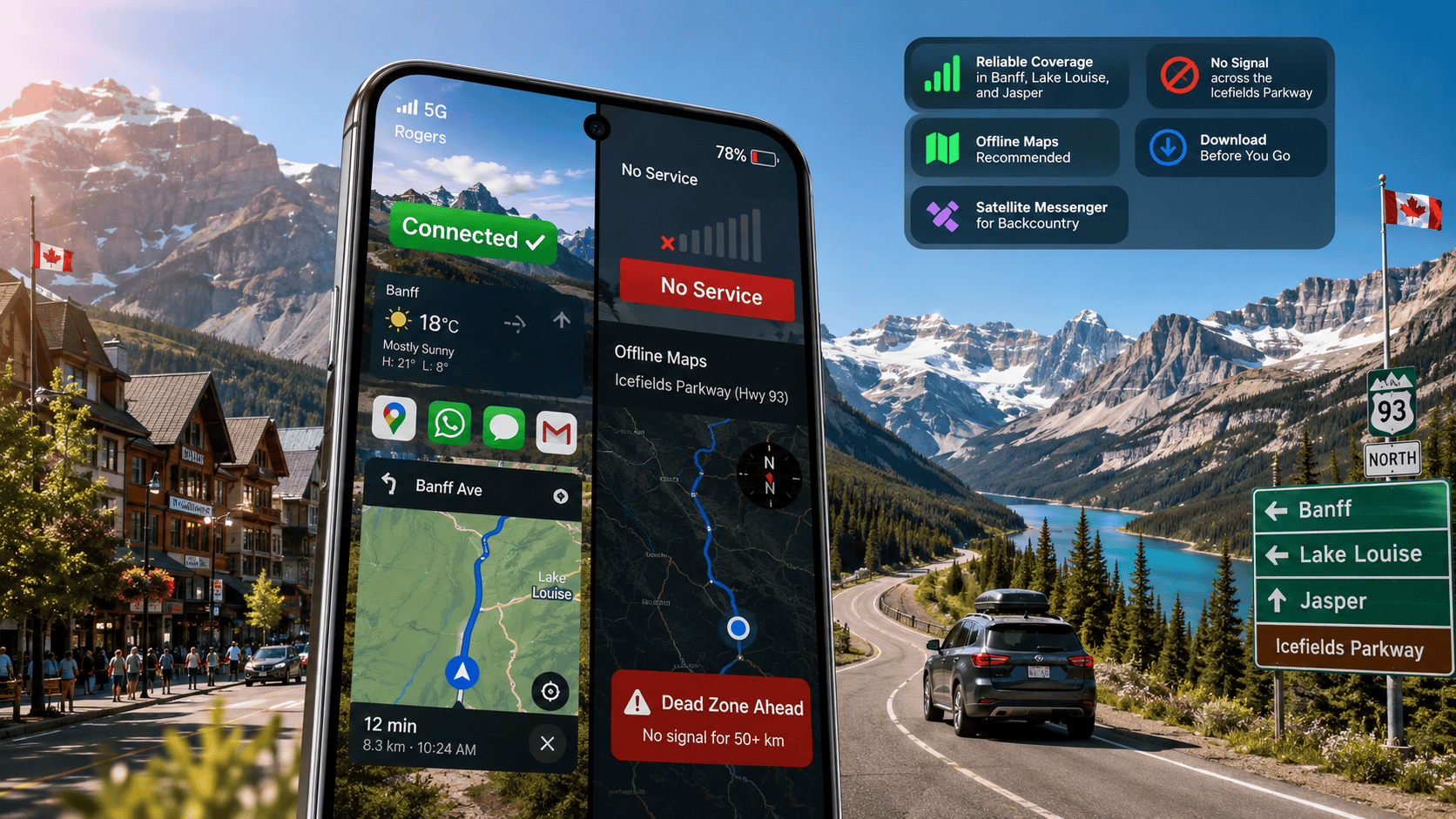
Cell coverage in Banff is reliable inside the townsite, but it disappears fast once you leave. On the Icefields Parkway between Banff and Jasper, expect almost no signal from any carrier for long stretches. Plan for offline maps and downloaded content before you drive into the mountains, no matter which network you use.
Key takeaways
- You'll get a usable signal in the towns of Banff, Lake Louise, and Jasper, but not much beyond them.
- The Icefields Parkway (Highway 93) is largely a dead zone end to end.
- The Big Three networks (Rogers, Bell, Telus) all thin out in the parks; no carrier fully covers the backcountry.
- Download offline maps, park info, and anything you need before you leave a town with signal.
- A local Canadian SIM or eSIM helps in town, but it won't beat physics in the backcountry.
Is there cell service in Banff and Jasper?
Yes, there's cell service in the town of Banff and around the Jasper townsite. Both towns are busy tourist hubs, so the major carriers keep decent coverage there. You can make calls, send messages, and use data in and near the towns without much trouble. Lake Louise village also has coverage, though it can get patchy at the edges.
The catch is distance. The moment you head onto a highway or a trail, coverage gets unpredictable. Treat any signal outside the townsites as a bonus, not a given.
Where does coverage drop out in the Rockies?
Coverage drops out along the Icefields Parkway and in the backcountry between the parks. If you drive Highway 93 between Lake Louise and Jasper, you'll have almost no signal the whole way. There's a long stretch — roughly from 20 minutes south of Jasper to about 10 minutes north of Lake Louise — with no reception on any network.
This isn't a problem with your phone or your plan. It's remote, mountainous terrain with few towers. Even a strong plan on the best network for your needs won't change that.
Which carrier has the best coverage in the national parks?
No single carrier "wins" the parks, but the big national networks give you the best odds in and near the towns. Rogers, Bell, and Telus all publish coverage maps, and reception in the townsites is generally good across them. Some travellers report Bell and Telus reception holding slightly better in spots, but experiences vary by exact location and season.
If you're considering Rogers specifically, our guide to Rogers 5G coverage in Canada explains why coverage is strongest in populated areas and becomes thinner in rural and mountainous terrain.
Before you rely on any network, check the official coverage map for your carrier. Here's how the parks break down:
| Area | What to expect |
|---|---|
| Banff townsite | Reliable coverage on major networks |
| Lake Louise village | Usable coverage, patchy at edges |
| Jasper townsite | Good coverage near the town |
| Icefields Parkway (Hwy 93) | Little to no signal, any carrier |
| Backcountry trails | Unreliable; assume no signal |
If you're arriving from abroad, sorting your connectivity before you land makes town-based coverage simpler. See how it works and compare plans so you're ready on day one.
How do I stay connected (and safe) with no signal?
Prepare offline before you lose signal, and don't count on your phone for emergencies in remote areas. A few plain steps go a long way:
- Download offline maps for the whole route (Google Maps and other apps let you save areas).
- Save park info, trail details, and any bookings as screenshots or downloads.
- Tell someone your route and expected return time before you go.
- Carry a paper map and know the emergency contacts for the park you're visiting.
- For serious backcountry trips, consider a satellite messenger or personal locator beacon.
Parks Canada publishes official safety and emergency guidance for exactly these situations. Read the Parks Canada emergency and safety page before a remote trip.
Quick jargon note: roaming means using a network other than your home carrier's, often for extra fees — if you're on a foreign plan, you may roam onto a Canadian tower in town and pay for it. A dead zone is simply an area with no cell signal at all.
Does a Canadian SIM help in the mountains?
A Canadian SIM or eSIM helps most in the towns and on major routes, not deep in the backcountry. An eSIM is a digital SIM your phone downloads instead of a plastic card. Getting on a strong local network improves your coverage in populated areas and can be cheaper than roaming on a foreign plan.
But be honest about the limits: no local plan creates towers where there aren't any. In the backcountry, everyone is offline. If you're weighing a local SIM against keeping your home plan, our guide on using a US phone plan in Canada walks through the trade-offs.
However, if you're travelling rather than moving to Canada, you can also compare SIM, eSIM, airport, and roaming options for Canada tourists.
FAQ
Is there Wi-Fi in Banff and Jasper? Yes. Many hotels, cafes, and visitor centres in the towns offer Wi-Fi, and some are free. It's a good backup for messaging and downloads when cell data is slow, but don't expect Wi-Fi once you're out on the trails or the parkway.
Will my phone work for emergency calls with no service? Sometimes. In many areas your phone can place emergency calls over any available network, even without your own signal — but in true dead zones there may be no network at all. Never rely on this in the backcountry; plan for no coverage.
Should I buy a SIM at the Calgary airport before driving to Banff? Sorting before or right after you land is smart, since Banff is a couple of hours from Calgary. If you're deciding between buying after arrival and arranging service ahead of time, see our Canada airport SIM card comparison. Ordering ahead means you're active on arrival instead of hunting for a kiosk. Compare Canada SIM plans to see what fits your trip length.
Do offline maps really work with no signal? Yes, if you download them in advance while you still have data or Wi-Fi. Your phone's GPS works without cell service, so a pre-downloaded map can still show your location. Save your full route before you leave town.
Which is better for the Rockies, Rogers, Bell, or Telus? All three cover the townsites reasonably well, and none fully covers the backcountry. Pick based on your overall needs and check each carrier's official coverage map for your specific stops rather than assuming one is best everywhere.
Heading to the Rockies soon? See how activation works so you arrive connected in town, then download your offline maps before you drive.
Follow Get Canada Sim on Google
Make Get Canada Sim a preferred source to find our latest Canada SIM and eSIM guides in Google Search.