

Do I Need an eSIM in Canada? An Honest Answer by Traveller Type
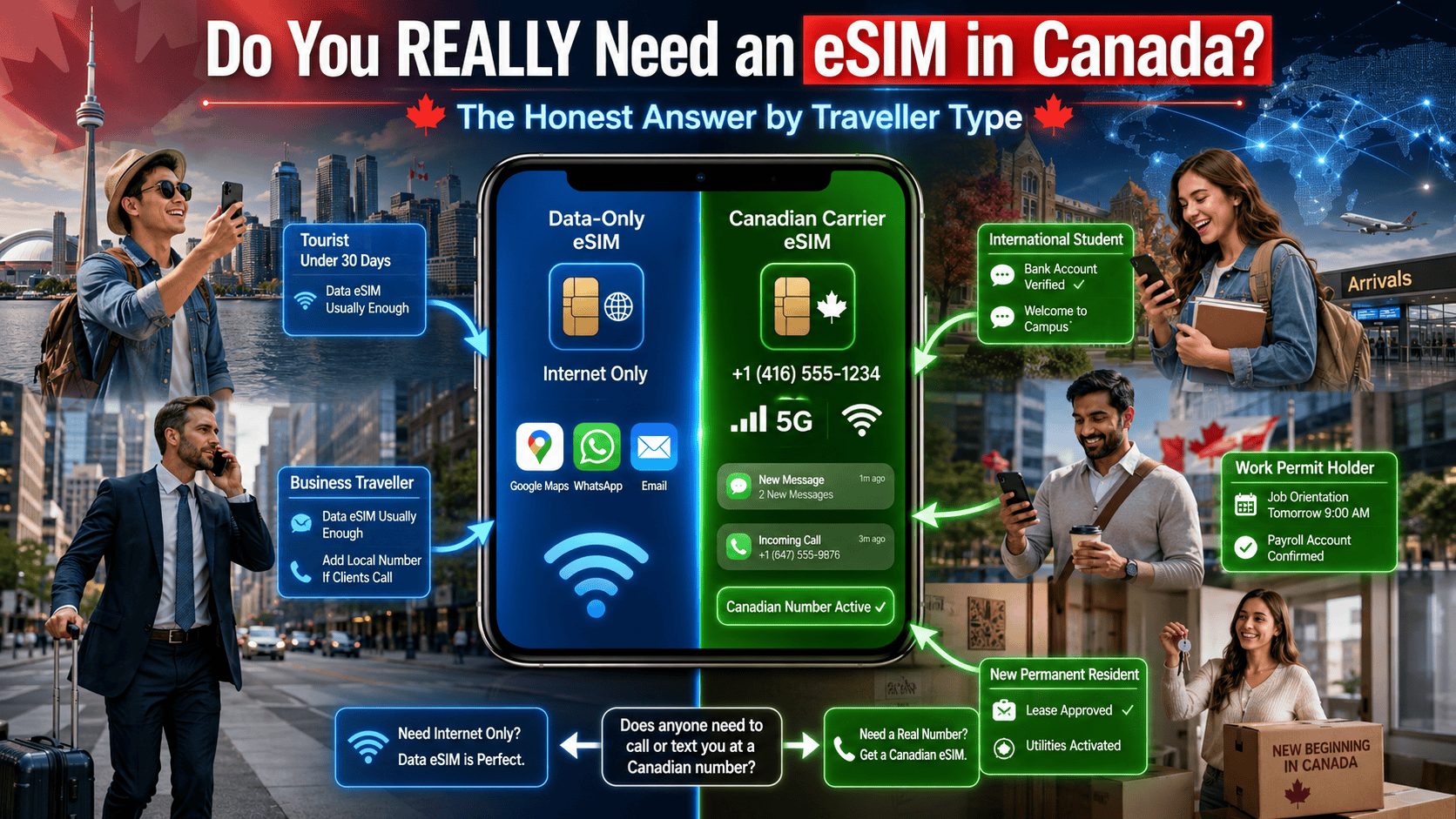
It depends on how long you're staying and whether anyone needs to phone you. A tourist on a ten-day trip often needs nothing more than a cheap data eSIM. A newcomer arriving on a study or work permit needs a real Canadian number from day one. Here's the honest answer for each situation, including the cases where you should skip buying anything.
First, the distinction that decides everything
Two different products get called "eSIM."
A data-only eSIM — Airalo, Saily, Nomad — gives you internet. Maps, WhatsApp, email, all fine. No callable phone number.
A carrier eSIM from a Canadian network gives you a real 10-digit Canadian number with calls and texts, exactly like a physical SIM.
Almost every "do I need an eSIM in Canada" question resolves once you know which of those you actually need. So: does anyone need to phone or text you at a Canadian number?
Tourist, under 30 days
You probably don't need a Canadian number. A data-only eSIM is cheaper and does the job. Saily starts around US$18 for 5 GB over 30 days; Nomad and Airalo are comparable. Your friends and family reach you on WhatsApp, you navigate on Google Maps, you book rides in-app.
Skip a monthly carrier plan. You'd be paying for calling minutes you won't use and a number you'll abandon.
One exception: if you're booking accommodation that phones to confirm, or renting a car, a callable number saves friction. Weigh that against the cost.
Business traveller
Usually a data eSIM plus your home number over Wi-Fi calling. Keep your work number reachable, add Canadian data so you're not roaming at $12–$15 a day.
If you're meeting Canadian clients who'll call you, a local number reads as more serious and is worth the small extra cost.
International student
Yes, you need a Canadian number, and you need it early. Not because of an eSIM technicality — because of what your first fortnight involves.
Bank account setup runs on SMS verification. Your university's emergency contact form wants a local number. Landlords screening student tenants call the local numbers first and ignore overseas ones. Part-time job applications ask for a phone number and employers actually ring it.
A data-only eSIM leaves you locked out of most of that. See the best mobile plans for international students in Canada for the specifics.
Work permit holder
Yes, and it's more urgent than for students. Payroll onboarding, benefits enrolment and two-factor authentication for work systems all route through SMS. Recruiters and hiring managers phone. If you're arriving with a job to start, a working number on landing day is the difference between starting smoothly and spending week one chasing verification codes.
Postpaid has a second benefit here: on carriers that report to Equifax and TransUnion, paying a monthly bill on time starts building the Canadian credit file you'll need for a lease or car finance. Prepaid builds nothing. More in does paying a phone bill build credit in Canada.
New permanent resident
Yes, and think beyond the first month. You're building a life, not managing a trip. A number you'll keep long term goes on your SIN paperwork, bank records, driver's licence application, lease, and every account you open. Changing it later means updating all of them.
Quick comparison
| You are | Data-only eSIM | Canadian number |
|---|---|---|
| Tourist, under 30 days | Usually enough | Optional |
| Business traveller | Usually enough | Helpful for client calls |
| Student | Not enough | Yes |
| Work permit holder | Not enough | Yes, before you land |
| New PR | Not enough | Yes, long term |
| Visiting family, staying with them | Their Wi-Fi may cover it | Optional |
When you don't need to buy anything
Staying under a week with family who have Wi-Fi, and nobody needs to reach you on the move? You may genuinely need nothing. Canadian airports, cafés and hotels all have free Wi-Fi, and WhatsApp over Wi-Fi covers calls home.
We'd rather tell you that than sell you a plan you'll cancel.
If you're moving rather than visiting
Then the answer is yes, and the useful follow-up is when. Ordering before you fly is normally around half the price of walking into a Canadian carrier store, and your number can be active up to 24 hours before you land — so it's working for the bank appointment you booked for your second day.
Compare plans — no contract, no credit check, nothing to pay today. Or read how to buy a Canadian SIM before you land for the full timeline.
FAQ
Do I need an eSIM to visit Canada?
No. You can use free Wi-Fi, roam on your home plan, or buy a SIM after you arrive. An eSIM is usually the cheapest and most convenient option, but it isn't required. Short visits staying with family often need nothing at all.
Is a data-only eSIM enough for Canada?
For short trips, usually yes — maps, messaging and email all run on data. It's not enough if you need a callable Canadian number for bank verification, employers, or landlords, because data-only eSIMs come with no phone number that can receive calls or texts.
Do I need a Canadian phone number as a student in Canada?
Effectively yes. Bank setup, campus emergency contacts, rental applications and part-time job applications all expect a local number, and most verify by SMS. A data-only eSIM leaves you unable to complete several of those steps in your first weeks.
When should I get my Canadian eSIM?
One to two weeks before you fly is comfortable. That leaves time to confirm your phone supports eSIM and is unlocked, and to install the profile at home while you have reliable internet. Activation can then be scheduled up to 24 hours before you land.
Follow Get Canada Sim on Google
Make Get Canada Sim a preferred source to find our latest Canada SIM and eSIM guides in Google Search.